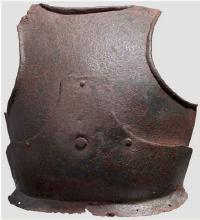
Breastplate late 15th c.
Built in the characteristic 15th c. style of 2 plates where the upper plate covers much of the chest and is overlapped by a lower plate that rises up in the center. The upper plate has simple, tapered, outward-turned rolls at the neck and arms. The roll at the neck is just slightly curved. There are two rivets for attachment of buckles at the shoulders, both of these are replaced, one has been moved somewhat to account for the loss of the end of the shoulder extension. There is another rivet right at the edge of the loss that matches the location of the rivet on the other shoulder. The lower plate has a flare at the bottom for the suspension of a fauld. There are 2 holes for the rivets to secure the fauld lames, a rivet remains in one hole. The 2 plates are presently secured by 4 rivets, the largest, central one of these would have originally been a bolt, the others are later additions. The lower plate rises to a wide peak at the center and it cut with 2 small cusps at the side. The edges of the central point are beveled over most of the edge. The bevel terminates before the cusps. This breastplate is of relatively heavy construction. The metal thickness by visual inspection in the center appears to be app. 3 mm tapering to app. 1 mm at the sides. These are estimates as it is hard to actually measure the thickness in its current configuration. A few actual measurements with a deep micrometer indicates that after the losses to rust the central upper breastplate varies between .115 and .150 in. in the center. The edge under the arm thins noticeably - the very edge is generally .040-.050 with one thin spot down to .030. Within 2 in. from the edge it thickens to .090 and then on up to the central thickness. The lower plate is more even in thickness and noticeably thinner - generally app. .050 in. It is basically a really large waist lame. There is some loss to one shoulder and at the center of the lower flare.
A very similar breastplate is illustrated as item 5.8 (page 89) in The Medieval Armour from Rhodes by Karcheski and Richardson. This item is in the collection of the Chateau de Grandson Switzerland. This breastplate is described as German or Italian end of the 15th/early 16th century. They also identify it as of the type called Fussknechtbrust - for use by armoured infantry. This one may be intended for mounted or higher-end use since the metal thickness varies from the center to the sides. Generally these simple 2 piece breastplates are attributed to late 15th c.
Measurements: (all taken straight on the inside) - width at the narrowest spot between the armholes - 9 1/2 in., width at the bottom of the armholes 14 3/8 in., width at the waist 12 1/4 in., height from waist to the top of the center of the neck 13 7/8 in., overall height 15 1/4 in.
Weight 6 pounds 10.6 ounces (3,025 g).
Not for sale.

German Gothic Breastplate circa 1480-1490
Composed. Formed of two pieces joined by a bolt. The main plate with a low medial ridge, plain angular, outward turned rolls at the neck and arm holes. The roll at the neck forming a vertical front edge then rounded over the top. The roll tapers nicely at the ends. The arm rolls of similar, but not as nicely executed form. The arm holes each with three one sided step flutes parallel to the rolls. Plackart rising to a central squared off point pierced with four hearts, the center with a vertical keel. The upper edges of the plackart with two parallel flutes. The outer of these is a step, the next seems symmetric. Bottom edge of the plackart flared to carry a fauld. The parts have been together for all of its modern history, but they are associated. The plackart and upper are secured to each other by a central bolt which threads directly into one of 4 holes pierced in the upper. The bolt is likely from the same period and the threads fit the threads in the upper. The top hole is cleanly cut, the bottom three are significantly mushroomed inward around the edges. As currently displayed, it sits a little tall, and the waist line will appear to be straighter than it would have been originally. Plates show signs of delamination and wear through cleaning. There are two small dents in the upper breast. These look like they may have been caused by impact from a square pointed weapon.
Weight: Total weight 4 pounds 12.4 ounces (2.169 kg) - upper breastplate 3 pounds 8.2 ounces (1595 g), plackart 1 pound 4.4 ounces (580 g).
Measurements: 9 7/8 inches wide at the top at the outside of the arm rolls, tapering out to about 10 1/2 inches where the armholes sweep out under the arms, 13 3/4 inches wide under the arms, 11 inches wide at the waist. Upper breastplate 12 7/8 inches tall at the center (measured straight on the inside). Neck roll 0.37 inch tall and 0.50 inch wide at the center. The roll tapers to 0.18 inch wide and 0.12 inch tall at the end.
Thickness: The thickness of the upper breastplate is extremely variable, between .019 and .097 inch. I expect that some of the thickness has been lost due to cleaning. If there is any pattern at all to the thickness, it would appear that the upper thins some under the arms and in areas that might have been covered by a larger original plackart. Plackart .038-.068 inch thick, pretty randomly distributed. As a guess the lack of intentional thickness management appears to confirm that these parts were originally part of lower quality armours.
Provenance - H. Wendel, Munich 1926, Stephen V. Granscay by 1933, Howard M. Curtis sold Christie's London 31 Oct. 1984 lot 273, a private French collection.
Exhibited - Brooklyn Museum 1933 no. 16, Rochester Museum of Arts and Sciences 1935, Allentown Art Museum 1964 no. 64 (illustrated in the catalogue on page 41).
Not for sale.

Breastplate circa 1490
German. Composed. Upper plate with outward turned triangular rolls at the neck and arms. The form of the upper breastplate and specifically its rolls with sweeping inner curves compares very well to the Gothic armours in Vienna made by Lorenz Helmschmied. Plackart formed of one main plate and two smaller plates. Plackart associated. Plackart lames somewhat reworked to fit upper. The results aren't bad looking from the front, but the profile is far flatter than it should be and the sizes don't match - the upper is far wider than the lower plates. Some modern internal patches in original plates. One end of the upper breastplate extended to match other side. Modern fauld of four lames. Upper plate fitted with a folding lance rest secured by two bolts from he inside. Lance rest described as modern in sale description. After removal and investigation the details of construction and wear indicate that there is a possibility that the lance rest is actually of the period, possibly even originally part of the same armour as the upper breastplate. It compares very closely to those which survive on the Vienna Gothic armours of the same period. There are also similarities to the lance rest on slightly later Mantova B-8. The bolts are also similar to one of those on the Mantova armour. Two modern buckles at the shoulders. The hinges were likely originally internal, there are recesses at the ends of the shoulder extensions which have filed notch decoration. This is covered up by the current external buckle mounts.
Ex. JW Higgins armoury inv. no. 802. From Dr Bashford Dean, Riverdale, New York, purchased from his estate, 28th September 1929. Exhibited Rockefeller Center, New York, 1 - 30 June 1965 and Brandeis University, Waltham, Massachusetts, 9 April - 16 September 1963. Listed as ref_arm_3748 in Matthias Goll's thesis.
Measurements: Breastplate: 13 1/2 in tall from the base of the neck to center of waist, 11 in. wide at the shoulders, 7 1/2 in. wide at the top of the neck, 10 1/2 in. wide at the narrowest spot between the arms, 14 3/8 in. wide under the arms and 10 1/4 in. wide at the waist. Lance Rest. The hinge portion is composed of 3 parts. The central part is part of the base, the two outside elements are part of the hook. The outer two knuckles are 1/4 in. thick. The central knuckle is just over 5/16 in. thick. There isn't a clean spot where the hinge actually is a full circle. But if I measure from the top to the flat spot on the bottom, it is just over 7/8 in. tall. Top to bottom 4 1/8 in. from end of point to end of point. The base arches app 5/16 in. above the level of the 2 points at the center to allow it to fit to the curve of the breastplate. From the center of the base to the end of the hook 4 3/16 in. Width of the base from the end of a point to flat spot 1 3/4 in. Holes are app. 1 1/2 in. apart on center. Weight of the lance rest: 8.6 ounces (245g).
Breastplate thickness (measuring in the upper breastplate, the least adapated part) .085 in. to .12 in. generally .095-.11 in. It seems to be a little thicker under the lance rest.
Not for sale.
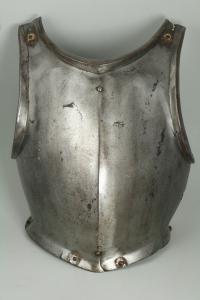
Italian or Flemish Breastplate circa 1500
Formed of a single piece with a medial crease, flared bottom edge and large triangular rolls at the arms and neck. The roll at the arm with engraved/filed decoration in the form of lines. There are a set of holes on the right side for the attachment of the pins for a lance rest. This is a fine example of a rare type of breastplate made at the turn of the 16th century. Examples like it may be found in the Waffensammlung Vienna, Metropolitan Museum NY, another in the current collection - item number A-321, etc. For a very similar example see Kienbusch Collection in the Philadelphia Museum of Art #1977-167-132 formerly in the Dean collection.
Size measurements: Width of neck hole - 8 1/2 in. Height of arm hole - 9 in. Arm hole to waist- 4 1/2 in. Center from top of roll to waist - 12 3/4 in. Waist flare - 3/4 in.
The metal varies in thickness. Within an inch it can vary about .01 inch. All measurements in inches. Thickness measurements:Sides - .028-.052 - mostly in the .030-.040 range. Upper area between arm and neck (right side) - .035-.050.Mostly around .040. Same thing (left side) - .059 - .075 (thicker than the other side). At the lance rest holes - .040 - .052. At the top crease area - .070 - .080 (mostly .080). At the center near crease - .080 - .11. Center near the waist - mostly .040 - .050. Height of upper roll at the center (measured with a gauge from the back of the material)- .66. Max height of right arm roll - .84. Max height of left arm roll - .71. Measuring from the front of the breastplate the rolls height and width at the widest spot are: right 3/4x13/16 inch, left 11/16x3/4 inch, neck 11/16x23/32. To generalize, the armourer was aiming for a roll about 3/4" high and about the same in depth (19mm).
Not for sale.

Breastplate circa 1500
For infantry use. Formed in one piece with strong medial ridge and large, tapered, angular outward turns at the neck and arm holes. Narrow flare at the waist with pairs of holes at each side for the suspension of the fauld lames. The rolls taper down to very fine ends. The form of the rolls is relatively tall and somewhat narrow. The faces of the rolls are flat and touch the main body at a very steep angle. These are often called triangular rolls, but the back "angle" is really a broad curve. The neck roll comes to a very subtle point at the center.
The mark is the same as that found on a right cuisse formerly in the armoury of the Dukes of Osuna, later in the collection of Francis Henry Cripps Day and also the left spaulder of an armour previously in the collection of Abrose Monnell. Typical of ones shown in Spanish and Flemish sources. Given its assumed provenance it was likely used in Spain. This is a fine example of a rare type of breastplate made at the turn of the 16th century. Examples like it may be found in the Waffensammlung Vienna, Metropolitan Museum NY, Bostom Museum of Fine Art, Musee do L'Armee, Kienbusch Collection in the Philadelphia Museum of Art, Mantova etc. Details of the form are very similar to the breastplate on armour B5 in Mantova (specifically the aggressively tapered rolls, curve over the top of the shoulder, high neck line and the central curve. There is a similar breastplate in the current collection: item number A-66. Painted on the inside with the number 4116 in black paint.
Measurements: height from the center neck hole to the waist flare 13 1/2". Width 13 1/4" under the arms, 10 1/2" at the waist, 11 1/8" at the shoulders, 10 1/2" at the narrowest point across the uppper chest (outside of roll to outside of roll on the inside). Thickness - overall thicker in the center, thinning at the shoulders and under the arms - generally app. .08-.09" at the center and .05 at the edges under the arms. There are spots at the edges under the arms down to .039 and some areas in the center left chest up to .120. Arm rolls reach .7 in. at the highest spot, the neck roll .75 in. tall at the center.
Weight 4 pounds 15.2 ounces (2.245 kilos).
Provenance: Nelson-Atkins Museum of Art in Kansas City, MO. from Bashford Dean, and probably part of the items sold over three sales in 1880, 1890 and 1896 of the Armoury of the Duke of Osuna and Infantado.
Not for sale.

Breastplate circa 1500-1510
Italian/Flemish. Likely for infantry use. One piece breastplate with central crease. Angular outward-turned rolls at the neck and arms tapering toward the ends. Flared bottom edge for a fauld. The top corner at the right shoulder has been bent after its working life. This is a plain, lower end version of the same style of breastplate seen in item number A-321 and item number A-66. The lower quality is reflected in the smaller size of the rolls and their cruder excecution. The shape is still good. It may have been for a larger person, or it was less fitted since it would have not been custom fit.
Measurements: 13 in. tall, 13 1/2 in wide below the arm holes, 11 3/8 in. wide at the waist. Thickness: center mostly .120-.140 with thick spots up to .150, side tapers down to .080, shoulders taper to .050, but only right at the edge more of the shoulder area is no thinner than .080. Rolls up to app. 1/2 in. tall at the center.
Weight: 5 pounds 11.6 ounces (2.595 kilo).
Not for sale.

Breastplate circa 1500-1510
Likely Italian or western European. Globose form. Outward turned, tapered angular rolls at the neck and arm holes. The roll at the neck is larger than those at the arms. The taper is intentional and carefully placed. Two fauld lames, the lower cut out with an arch at the center, the arch with a narrow inward turned roll. The rolls at the neck and arms have a nice angular form but they are crudely excecuted showing many areas of pucker that happened when the rolls were formed. Even at this level the taper and form show real intent and the form will act like a "stop rib" at the neck and arms. The overall form of the piece and quality of the rolls indicate that this would have been a munition piece for use by a common soldier on foot or light cavalry. Left shoulder repaired with an internally riveted patch. To see nicer rolls of a similar form see item number A-239. For really nice examples of the style of rolls see item number A-321 and item number A-66.
The style of damage and repairs are consistent with pieces that came from the Rhodes finds and were conserved/restored/sold through Bachereau in Paris in the late 19th and early 20th c. The Rhodes pieces and their history is discussed in the book "The Medieval Armour from Rhodes" by Karcheski and Richardson. This piece is not included in the book. The closest comparable breastplate that is published is 4.28 which is now preserved in the Met (29.150.88) which is identified as Italian c. 1490. The description compares that breastplate to a number of survivals and depictions in art which include both Italian and western European pieces including some from Innsbruck/Muhlau in Churburg. The specific shape of this piece leads me to believe that it is from the early 16th c. and for munition use - the neck line is relatively flat and the waist is not as narrow as it would be on a higher end piece. Other possible Rhodes pieces in the Allen collection include item number A-217 and item number A-68. Another source for late 15th/early 16th c. pieces in excavated condition is St. Irene in Istanbul. These are less well documented.
Two fauld lames at best associated but possibly later (first) and later (second). The patch at the shoulder is either very old (19th c.) or intentionally aged on the inside to minic the original material. It appears that the shoulder patch and fauld work were done at different times - my feeling is that the fauld work was later. Illustrated in Andrew Garcia's book "The Collector's Course on Medieval Arms and Armor" on page 120.
Measurements: Weight: 5 pounds 2.8 ounces (2350g)
Not for sale.
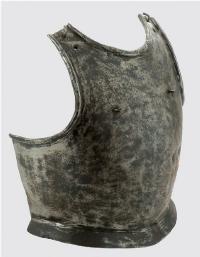
Breastplate 1500? 17th c.?
Breastplate. Very heavy construction. Rounded form. Flare at the waist. Squared tapered outward rolls at the neck and arms. Holes for shoulder straps and turning hooks for use with plate covered shoulder straps like a trooper's breast in the 17th. century. 2 dents from bullet shots in the center left of the breast. The form and rolls are what you would expect of a breastplate of c. 1500. Weighs app 18 pounds. I know that I have seen a pile of similar breastplates that are associated with a group of 17th c. pieces. The weight, bullet marks and shoulder pin locations are reasonable for a 17th c. date. Outward turned rolls like this are very much not normal for the 17th c., but I have seen very heavy breastplates which are at least turned out. The square fom of the rolls is very odd. I don't see any reason to expect that this is a later piece, but attribution to a common type is difficult.
Not for sale.
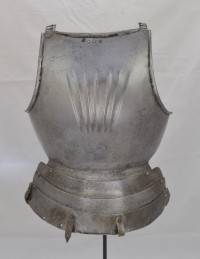
Breast and Back plates circa 1505-10
Breastplate formed of one piece. Globular form. Simple outward turns at the neck and arms. The rolls are tapered with a rounded profile on the outside, with a subtle crease in the front forming a very crude triangular roll. Short spray of flutes at the center composed of 5 full flutes with two step (one sided) flutes - one on each side. The flutes are accented by engraved lines. Pierced for laces at the center of the neck and with two marks. Waist flared to carry a fauld of 3 lames. The fauld lames secured to the flare by rivets and to each other by sliding rivets at the side. The bottom fauld lame has a narrow outward turn at the center which is slightly boxed. The breastplate is cut out at the sides of the waist. The sides and ends of the fauld lames extend significantly past the waist. This is typical of armours around 1500. Two buckles at the shoulders. Both appear to be old, but they are probably both associated. One is too nice for this simple armour and the mounting plate is decorated so that it appears to have been originally designed to be used on the surface of a piece of armour. Backplate formed of three plates with raised borders at the neck and waist and with one full flute and two one sided flutes at the center. These flutes are not accented with engraved lines. The back has a very full, rounded shape. The breast and back are secured by straps at the shoulders and would have been secured at the waist by a strap and buckle secured to the back plate. Leathers depend from the bottom plate of the fauld to secure tassets. All leather straps replaced. Given the way munition armours appear to fit, it is reasonable to assume that these breast and back really do form a cuirass. Nice example of a simple munition breast and back from the very beginning of the 16th century. A very similar cuirass is listed in "The Kretzshmar von Kienbusch Collection of Armor and Arms - Princeton University Press 1963 (cat. no. 123, pl. LVIII), which is described as having come from the Bayerisches Armeemuseum, Munich and that a number of similar cuirasses are said to have been worn by the town guard of Munich in about 1500. This collection is now held by the Philadelphia Museum of Art.
Measurements: width between the arms 11 1/4 in., top center of the neck roll to the waist 13 1/4 in., width a the arm holes 14 5/8 in., width at the waist 10 1/8 in.(given the cut into the edge of the waist, it is wider than this at the real waist), fauld lames 1 3/4 - 1 7/8 in. tall at the center, backplate 13 in. wide across the top, 13 3/4 in. wide under the arms, 1 3/4 in wide at the waist, 12 1/2 in. tall at the center.
Thickness: variable - a few sample measurements indicate app. .090 in under the flutes in the center, .070 about half way around on the left hand side and .050 at the side under the left arm. Fauld mostly .030-.040, if there is a pattern they are thicker in the center. Backplate generally .040-.078, most thicker spots near the waist and upper right corner. Some spots up to .070 in. thick. Most of the surface .050-.060, thinning at the shoulder blades.
Weight: breastplate and fauld 5 pounds 15 ounces (2690 g), backplate 3 pounds 5.2 ounces (1505 g).
Not for sale.
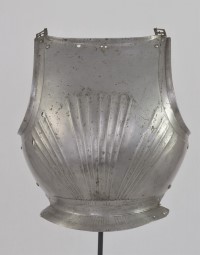
Maximilian Breastplate circa 1505-15
Of shallow globose form with three sprays of flutes radiating from the waist. There are seven flutes in the center spray and 5 in each of the side sprays. The outermost flute on each of the side sprays is really a step - a single sided flute. Neck with an angular inward turn. Arms with sliding gussets with similar angular inward turns. Wide waist lame. Fauld missing. Flutes accented by parallel engraved lines and semi-circular engraved ends. Waist lame with horizontal engraved lines and shallow engraved lines continuing the flutes from the breastplate and suggesting the flutes on the missing fauld. Waist lame cut out at the sides. Each gusset has a buckle at the top to secure the breastplate to the backplate. One of the buckles is likely original the other appears to be a well matched copy. The surface shows signs of rust, cleaning and delaminations. A very similar breastplate forms part of a half-harness in the Fitzwilliam Collection #M.1.3-1936 (cuirass catalogued as M.1.3.C-1936) identified as German, 1510.
Measurements: width at the chest under the arms at the corner of the gussets 13 3/4 in. width at the waist 9 in. (given the cut into the edge of the waist, it is wider than this at the real waist) width at the bottom of the main plate corner to corner 10.4 in. width of the main plate at the top 8.6 in. width at the top including the gussets 9.8 in.
Thickness at the sides .030-.042 with at least one spot on the left side down to .020, top edge app. .050 (varying between .040 and .065, but mostly .050-.055, at the top of the central flute spray .075-.095, the thickest spot in the center generally .090-.120, mostly .095-.10. The thickness is current after some significant loss and cleaning to the outside (some of the engraved lines are nearly erased), it would have been measurably but not significantly thicker.
Weight: 4 pounds 3.8 oz (1930 g).
Not for sale.

Breastplate circa 1510-20
Italian fluted in a German style. Formed with a deep globose shape. Rolled at the neck with a large, angular inward turn. Arm holes bordered by gussets which are formed with a flare with the edge bent back, not a full roll. This style of simplified gusset appears on very late 15th and early 16th c. munition pieces. The waist is flared for a fauld. The center of the breastplate is fluted with a series of parallel vertical flutes terminated by a recessed band at the top and bottom. All of the flutes are accentuated by engraved lines. Marked below the center of the neck hole with a maker's mark - possibly a crowned crossbow bolt. Given the thickness this breastplate was most likely intended for infantry or light cavalry use with later holes for a lance rest. Two later internal patches. Fauld lames missing. Similar breastplates are preserved in the Museo Stibbert Florence (cat. no. 5) which is more complex and has roped rolls, Windsor castle, Mendlesham church in Suffolk, England, the Cleveland Museum of Art (with roped rolls on the gussets, inv. num. 1916.1640), Art Institute of Chicago (part of infantry armor dated 1510-15 inv. 1982.2427b-f) and the Schweizerisches Landesmuseum, Zurich - which is very similar, displayed in the arms drill display with other early 16th c. infantry armour.
Measurements: 14in. (35.5 cm.) high, 11 1/2 in. wide across the gussets, 13 in. wide under the arms, 11 in. wide at the waist, gusset flares app. 5/8 in. tall, center of roll at the neck app. 3/4 in. on each side of the triangle, tapering to 3/8 in. tall and just folded over at the end.
Thickness: .050 in. at the side, mostly .070-.080 in the center. Gussets vary significantly - .040-.080 in. There does not seem to be a particular pattern to the variation.
Weight 4 pounds 2.8 ounces (1895 g).
Not for sale.

Breastplate circa 1510-20
Globose form with a shallow central crease. Neck with angular inward turned roll. Arms with simple flared and inward-turned gussets. This style of simplified gusset appears on very late 15th and early 16th c. munition pieces. Waist flared to carry the fauld. Very early transition form between late 15th to early 16th c. forms and the more rounded form typical of the Maximilian style. Upper turn and gussets similar to item number A-216. Earlier form illustrated by item number A-66, item number A-321 and item number A-239. Slightly later forms illustrated by item number A-225 and item number A-216. A likely slightly earlier breastplate that shares the form of the upper roll and gusset flares can be found in the KHM (item number A 2154) attributed to Innsbruck (?) and dated to c. 1500.
Measurements: Thickness: This piece is less intentionally managed than many indicating (along with the simple gussets) that it was likely a munition piece. There is a thick area that is .098 in. thick. Generally the center is .07-.08 in. thick and the edges under the arms thin down to .060 in. or a little less. Gussets .038-.050 in. in the unfolded base.
Weight: 4 pounds 8.2 ounces (2045g).
Not for sale.
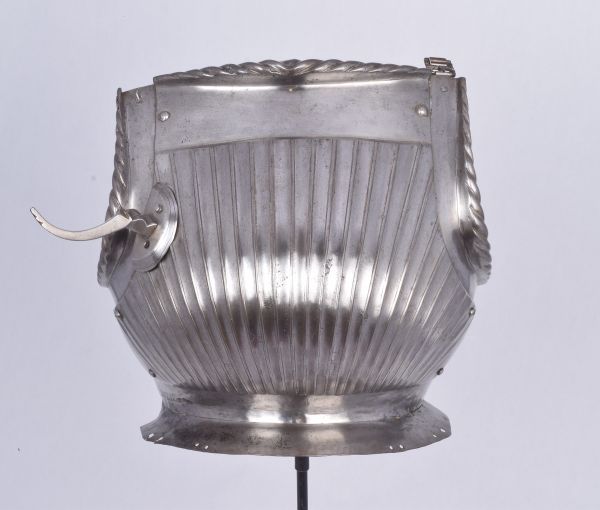
Breastplate circa 1520
German. Deep, full globose form. Moveable gussets at the arm holes. Large, aggressively tapered, boldly roped (with double engraved lines) inward turned rolls at the neck and arms. The roll at the neck changes direction at the center. Tall waist lame. The surface mostly covered in vertical flutes each accented with parallel lines radiating from the bottom. There is a plain band at the top below the roped edge. The breastplate pierced with a pair of holes for a lance rest. The lance rest is secured to the breast with two bolts (one lost). The lance rest is hinged to allow it to be flipped up out of the way when not in use. One buckle remains at the top of the left gusset. There are two round punch marks in the center of breastplate. One is just below the roll, the other at the base. These are often present and appear to be registration marks helping in the forming of the piece. Small signs of delamination. Small areas of pitting. Heavy hammer marks on the interior. These include some interesting marks which show that the maker "got lost" making some of the flutes.
The waist lame is described as associated and the lance rest as restored in the TDM sale entry. There is no mention of the lance rest or association of the waist lame in the Parke-Bernet entry, but the description is very minimal and the lot is not illustrated. Inspection confirms the patch in the waist lame and I think that the waist lame is probably slightly re-worked to fit the breastplate. The patch is modern. The lance rest is well made and functions, but it does appear to be later, confirming the DelMar description. The bolt securing it may be original, though associated.
Measurements: Thickness: (highly variable) generally 0.10 at the center and 0.06 under the arms. Weight: 6 pounds 2.4 ounces (2785g).
Provenance: William Randolph Hearst sold December 4 1952 lot 135 Parke-Bernet Galleries later sold June 27 2012 Thomas DelMar lot 394 .
Not for sale.

Breastplate with fauld circa 1530
Italian or Flemish. Full rounded profile rising to a central crest over the top three quarters of the breastplate. Large inward turned roped rolls at the neck and arms. Roping with simple double lines. Arm holes formed of gussets. Slightly flared fauld of 5 narrow plates. Bottom plate flared at the center at the crotch with a rolled, roped and recessed border. Rivets remain on the bottom plate for straps to secure the tassets. Interior holes, rivets and one leather at the center of each side. One buckle remains at the top of the left gusset. The inside of the breastplate and right gusset are marked with four round punch marks. The other gusset and fauld lames may be marked with a single diagonal chisel mark. Interior with old blackened finish. Exterior with old patina. Interior painted with MM. One gusset slightly bent. There is a patch on the upper right corner of the middle fauld lame. It is riveted inside and hammered flush to the outside.
Measurements: 19 1/2 in. tall overall, breastplate 14 in. tall, 12 in. wide at the waist, 13 3/8 in. wide under the arms, 12 in. wide at the top. Fauld 16 in. wide at the bottom, one end of one lame deformed, likely 15 1/2 in. wide originally. Fauld lames vary in width. The top one is app. 1 1/2 in. tall, the second through fourth are app. 1 1/4 in. tall and the terminal lame varies between 1 3/4 and 2 in. Thickness: Breastplate .055 at the edge under the arm, generally .090-.110 over most of the body of the breastplate then thinning to .075 in near the crease. Fauld lames generally around .060, but extremely variable - there is a small area of the 4th lame near the center that is .10 in. thick.
Not for sale.
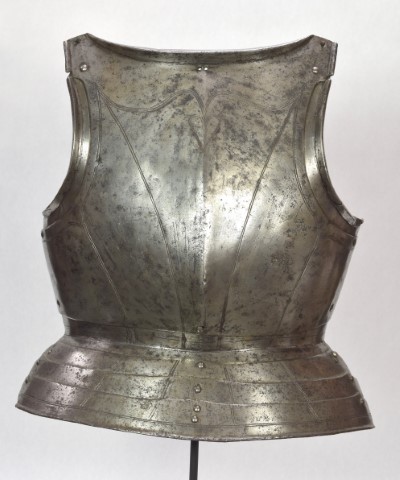
Breast and back plates circa 1550
Breast and Back. Set up for infantry use. Decorated with pairs of incised lines (at the top border, tripples). Backplate with simple rolls at the arms, neck and base of the waist lame. Waist formed of a large waist lame. Additional lame at the top. Each plate attached by 3 sliding rivets. Breast with a central ridge of globose form. Neck and arms with outward triangular rolls. Arm holes with fixed gussets. Fauld of 3 lames decorated en suite with the breast and back.
The breastplate was "updated" for use in the mid 16th c. It started it's life as a heavy cavalry breastplate made about 1515.
Not for sale.

Lower-German Breastplate circa 1550-1560
Heavy hammered polished iron breast plate with strong projection in the medial ridge and triple extruded curved V-lines under a centrally subdivided roped flange. The left side etched (faded) with a crucifix and kneeling knight. Inset gussets with high roped turnovers. Riveted waist lame. The arm holes are bordered by a narrow recessed band. The bottom edge heavily beveled with a decorative notch at the center. The inside with distinct tool marks, the iron slightly raised in places, the double holes for the lance rest filled in the distant past. Rivets replaced. Close inspection of the surface shows that waves that indicate that it was likely originally "rough from the hammer" and black in the areas outside of the etched figure. This combination of finishes is common in many other examples of breastplates of this style with an etched scene.
Height 12 1/2 in. (32 cm). 11 1/2 in. wide at the waist, 15 1/2 in. wide under the arm holes. 11 1/2 in. wide at the top with the gussets fully extended.
Thickness on a line from the center point to the central point of the left arm roll .156 in. up to .210 app. 1 1/2 in. from the center to .170 at the corner. Along a line 1 in. up from the bottom edge from the center to the outside .160 in. at the center thinning down to .10 at the rivet securing the waist lame down to .075 near the edge. Upper half more consistent ranging somewhat randomly between .170 to .210 with a few spots reaching .230. Up at the top corner of the arm hole thining down to .120 in. Waist lame in the upper facet .132 in. near the center tapering to .055 in. at the edge 'Flare' less even and generally thinner varying between .110 in. to .045, mostly between .070 and .090 in. Left gusset - measured where it does not overlap - .040 at the top, .060 at the back and rising to .070 above the center. Right gusset .050 at the top, .040 at the back but rising to an impressive .108 above the center front. Overall there is a good bit of variation in thickness in the gussets. Overall pattern of thickness in the breast itself .20 thick near the center, tapering to .070 at the sides and .150 at the top.
Exhibited: Feb. 10 2023-Feb. 29 2024 Orange County Historical Museum Hillsborough NC
Not for sale.
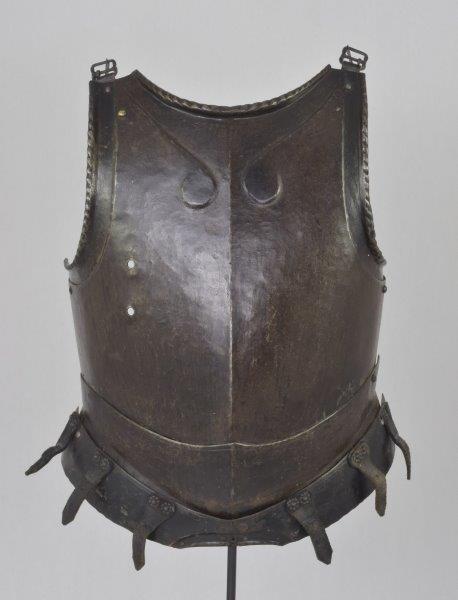
Breastplate circa 1550-60
Breastplate. Rough from the hammer. Of long waisted form with a single articulated lame at the waist. Sliding gussets at each arm. Heavily roped rolls at the neck and arms. Single fauld lame. Upper breast decorated with a pair of volutes. Pierced with two holes for a lance rest. Buckles at the shoulder replaced with modern copies made to match the surviving buckles on the tassets. Tasset leathers replaced, mounted with nice modern rosette washers. Apparently forms a cuirass with item number A-1-d. Displayed as part of item number A-1.
Measurements: Thickness: varies significantly. Generally .075"-.08" in the center but there are small areas that are up to .10" sides generally about .060" lower lame .055" gusset .040"-.045".
Not for sale.

German Breastplate circa 1550-60
Aggresive central crease rising to a rounded point. Sliding gussets at the arms with large inward turned, roped rolls. Large inward turned rolled roped edge at the neck, with a recessed border curving down to a central point. There are 3 types of marks on this piece. There are 2 larger marks near the neck. Nuremberg Guild mark and Vienna arsenal mark. There are also 6 round punch marks that indicate the locations of the center below the roll, center at the waist flare, arm holes and the sides of the waist. Integral flare at the base for attachment of the fauld (instead of a separate waist lame). Holes in the flare for articulation toward the outer end and pairs of holes for leathers in app. the middle of each side. These would be used to secure 2 interior leathers connecting the fauld lames which would terminate on the terminal fauld lame at a location which aligns with the center of the tassets. The overall shape of this breastplate is similar to that of item number A-241. This shape is typically associated with Innsbruck.
Height 14 in. (50 mm), 12 in. wide at the waist, 14 1/2 wide under the arms and 11 1/2 in. wide at the top with the gussets fully extended. Neck roll 1/2 in. wide and 3/4 in tall at the center tapering to 1/4 in. wide and almost flat at the ends.
Thickness. Max. .187 in (app. 1/2 way between the point and the center of the arm hole). Highly variable thickness in the middle, generally between .130 and .160 in the central 1/3 of the breast. .047-.055 at the right edge. .068-.092 in. 2 /12 inches in from the right edge (the line under the lower rivet securing the gusset). .108-.122 in. near the center below the 'point'.
Weight: 7 pounds 2 ounces (3,250 g).
Not for sale.

German Breastplate circa 1550-60
Breastplate. Black and white. Sliding gussets at the arm holes and 2 fauld lames. Drawn out to a blunted point somewhat below center. Rolls at the neck and arm holes tapering from the center and roped. Background rough from the hammer and painted black. Bands raised and polished. Central band tapering toward the waist on both the breast and fauld lames. One raised band on each side. Top of breastplate with wide scalloped raised area. Lower fauld lame with central arch cut out and rolled and roped edge. All parts originally part of the same piece. Buckles at the shoulder end of the arm gussets. Painted number 3946 in large numbers on the inside of the breast. A nice, basic, munition black and white breastplate from the mid 16th century.
Not for sale.
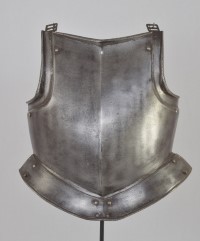
Breastplate circa 1550-60
With a central crease drawn out to a rounded central point. There is a small rectangular hole near the center of the neck. This appears to be for securing the peg that would be used to secure the buff. The edges of the breastplate at the arm holes and sides are heavily beveled. Tapering inward-turned rolls at the neck and arms. Arms with sliding gussets. Gussets and upper roll with fine roping. Waist with a single lame fauld with turning pins at the sides for securing a removeable fauld. The single fauld lame has a roped roll a the bottom edge. The central hole at the neck and decorative style indicate that this is likely of Brunswick origin.
Measurements: height 13 3/4 inches from the center of the waist to the center of the top roll. Width 14 inches under the arms and 12 3/4 at the waist. 10 3/4 inches wide at the top with the gussets out, 10 1/8 inches when they are pushed in fully.
Thickness: varies significantly, but there doesn't seem to be an intentional pattern to the thickness changes. Generally around .180-.190 in (4.57 mm - 4.83 mm). Some thick areas .220 inch, thin areas .150 inch. Gusset ranges from .055-.075 inch. Fauld lame .030-.040 inch. .
Weight 10 pounds 9 ounces (4800g).
Not for sale.
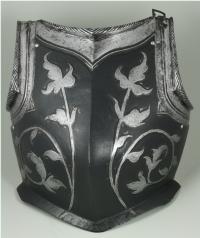
Breastplate circa 1550-60
Innsbruck. Officer quality black and white with embossed vine and leaf decoration. Moveable gussets at the arms. Large, tapered, roped rolls at the arms and neck all coming to a point at the center. Original buckles at the top of the gussets, one damaged. Rolled borders of the arms augmented with a narrow embossed line at the center of the gusset. The neck accented by a raised polished section with a parallel raised liine and a small secondary chevron at the center. Roping aparently filed - the rolls with an overall even (not embossed for the ropping) surface. Breastplate with a central crease and deep rounded point at the center. De-laminations on the inside in the lower section of the point and some small ones on the surface. One old patch near the center of the flare and one later patch at the left fauld rivet hole. Black refreshed, white areas lightly cleaned. Gusset rivets replaced. Note from Ian Eaves states:
This is actually a nice piece: an officers quality black and white armour made in Innsbruck about 1550-60.
The main maker of such armours was Michel Witz the Younger (see for example an armour preserved in the arsenal at Graz). Particularly close in style is an armour by Sebastian Katzmair of Innsbruck in Schloss Churburg (no 118 in the Trapp , Mann catalogue of 1929 as I recall).
The breastplate decoration is very similar in form to the breastplate on CH S118 in Churburg (illlustrated page 329 of the new 1996 catalogue and plate LX (b) in the 1929 Mann and Trapp catalogue) and the armor illustrated as plate 74 in the 20th anniversary catalogue of the Lauder collection at the Neue Gallerie (in that case, with an undecorated cuirass).
Weight: 6 pounds 9 ounces (2975g).
Measurements: Height 13 1/2 in from center of neck roll to center of waist flare, 15 1/2 in. from top to bottom of center point of the flare, 11 3/8 in. wide at the waist, 13 1/2 in. under the arms. Slot in the gussets app. 3/4 in. long. Thickness: highly variable even in small areas. Thickest spot found in a quick check 0.179 in. Generally the center is 0.14-0.15 in. Tapers down to 0.084 at the wearer's left side under the arm.
Not for sale.

Breastplate circa 1550-80
German. Black and white with rough from the hammer surface with raised polished bands. The neck with a tapered inward turned roped roll. The arms fitted with gussets (left gusset associated) with inward turned tapered rolls, the right roped en suite with the neck. Retains fauld of 3 plates. Cleaned bright over its entire surface. Reblackened with paint to simulate the original appearance. The interior of the breastplate marked with assembly marks which match those on the second fauld lame and appear to match the marks (less distinct) on the original gusset. Polished bands at the center, middle of each side and sides of the breastplate which continue on the fauld (except on the right side of the upper two fauld lames where it appears the original maker omitted the bands). The bands on the breastplate are very roughly formed on the outside, tooling appearing to be made by very small, narrow pien. The bands in the fauld more cleanly made, likely because raising bands on the thinner material is easier. A single line of holes in the center of the fauld lames for a (lost) internal leather. The terminal lame of the fauld with pairs of empty holes left and right of the center along with an additional hole past the articulation rivet. These would have been used to secure a pair of straps on each side for suspension of tassets.
Not for sale.

Breastplate circa 1550-80
German. Black and white with rough from the hammer surface with raised polished bands. The neck with a tapered inward turned roped roll. The arms fitted with gussets with inward turned tapered rolls. Retains fauld of 3 plates. Reblackened with paint to simulate the original appearance. Polished bands at the center, middle of each side and sides of the breastplate which continue on the fauld. The bands on the breastplate are very roughly formed on the outside, tooling appearing to be made by very small, narrow pien. The bands in the fauld more cleanly made, likely because raising bands on the thinner material is easier. small patch in the flare for the fauld. Retains rivets for leathers in the fauld. These are located int the raised bands in the middle of each side of the fauld. Area in the upper half of the inside of the breastplate cleaned.
Measurements: 11 1/4 in wide at the waist, 14 in. wide under the arms, app. 10 1/4 in. wide at the top of the breastplate, 12 1/2 in. tall breastplate at the center to the waist, 17 1/4 in. tall overall including the fauld. Breastplate varies between .040 and .070, mostly .060-070 in. thick. Fauld thinner - mostly .030-.050. This breastplate is smaller and thinner than most.
Not for sale.

Breastplate circa 1550-80
German. White. With a central crease and drawn out to a point below the center. The neck with a tapered inward turned roped roll. The arms fitted with gussets with inward turned tapered rolls. All rolls with matching roped decoration. Retains fauld of 2 plates which would extend out in the center over the crotch, forming a simplified version of the faulds where the center of the bottom lame is pushed out over the cod piece. Lower plate with 2 (probably later, but possibly working life) leather straps which may be buff for the suspension of tassets. Gussets with buckles for the shoulder straps. Interior of both fauld lames and left gusset marked with a single punch mark that appears to be the assembly mark.
Not for sale.

Breastplate circa 1550-80
German. Black and white with rough from the hammer surface with raised polished bands. The neck with a tapered inward turned roped roll. The arms fitted with gussets with inward turned tapered rolls. Retains fauld of 3 plates, the lowest with a central arched cut out with an inward turned, roped border. Purchased cleaned bright, then reblackened with paint to simulate the original appearance. Polished bands at the center, middle of each side and sides of the breastplate which continue on the fauld. The bands on the breastplate are very roughly formed on the outside, tooling appearing to be made by very small, narrow pien. The bands in the fauld more cleanly made, likely because raising bands on the thinner material is easier. Small interior patch at the upper corner under the left arm. Patch riveted in and the outer surface ground smooth. Old, possibly working life patch. Assembly marks of 3 punches of a squared punch on the inside of the breastplate, gussets and all three fauld lames. Holes in the fauld lames for (lost) interior leathers at the center of the white bands in the middle of each side. Relatively modern D shaped buckles at the top of the gussets. There is a area in the upper half of the inside of the breastplate that appears to have been formerly painted with inventory marks. Minor delaminations at the edges of the breastplate, some cracking in the center fauld lame. The decoration on the roll at the center of the bottom fauld lame is very different from the roping on the gussets and top of the breastplate, but the matching assembly marks indicate that they are not associated.
Measurements: 13 in. wide at the waist, 15 in. wide under the arms, app. 11 in. wide at the top. Breastplate 13 1/2 in from center top to waist, 19 in. tall overall including the fauld. The breastplate varies between .070 in. and .105 thick. Fauld lames generally .050-.060.
Not for sale.
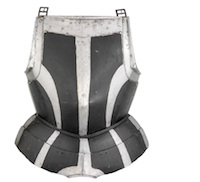
Breastplate circa 1550-80
German. Black and white. Rolled neck, gussets at the arms, fauld of two lames. Drawn out to a blunt point at the center and with a central crease. Tapered, roped roll at the neck with two lines at the center and roping sloping in opposite directions on each side. Gussets with large, tapered rolls coming to a slight point at the center and roping with a pair of lines at the center and opposite sloped roping at the top and bottom. Three raised bands, one at the center and an arched one on each side. The top with a recessed border that comes to a shallow point at the center. Fauld of two lames continuing the raised bands from the breast and with two additional bands at the ends which would have continued those on the tassets. Center of the second lame with a shallow arch with an inward turned roped border. Buckles at the top of the gussets. Background rough from the hammer with a black finish refreshed with paint. The decoration cleaner and nicer than that on several others from the same source. Breast, one gusset and both fauld lames with internal assembly marks formed of 3 punch marks.
Not for sale.

Breastplate circa 1560
Black and white with a pronounced point below the center of the chest. Neck bordered by an inward turned, tapered, roped roll. Arm holes bordered by sliding gussets with inward turned, tapered, roped rolls. Waist flared for the fauld. Breast decorated with recessed polished bands, the overall surface rough from the hammer. There is an indistinct mark at the neck. Reblackened. There are buckles which appear to have been manufactured by being pierced from sheet at the shoulders. They attach to the inside of the gussets. This would suspend the breastplate and serve to return the gussets to the outward position. One missing its tongue and detatched.
Measurements: 13 in. from the center of the neck roll to the waist, 10 1/2 in. wide at the outside of the gussets when extended, 9 3/4 in. wide with the gussets compressed, 14 5/8 in. wide under the armholes, 13 7/8 in. wide at the waist.
Weight: 4 pounds 3.2 ounces (1905 g).
Not for sale.

Breast and back plates circa 1560
breast-plate with medial ridge drawn-out to a central point and with a separate waist lame forming a flange at the base, the upper edge prominently turned and roped above an inverted double ogee-shaped border, movable armhole gussets with edges roped en suite, single riveted skirt and back-plate with two small side plates, waist lame and culet all en suite with the breast-plate. Almost certainly from the same series and well matched in style. Both the breast and back of relatively heavy construction for munition pieces. The back may be from a somewhat shorter cuirass. The rolls on the breastplate and gussets are nicely tapered and elegantly roped. Roping changes direction at the center where the center is accented with a central bump with roping. Bottom of the fauld and culet lames with inward turned roped rolls. Ends of the rolls on the backplate under the arms and on the culet terminate allowing for easy overlap under the breastplate. Originally rough from the hammer and blackened. Breast marked with 5 round punch marks near the neck and 4 chisel marks on the inside of the neck roll. Lightly cleaned. Most rivets replaced. Some do appear to be original. There are four rivets that secure the breast to the waist lame which have remnants of pewter rosette washers, patches and some laminations secured with original rivets. Re-leathered. Buckles replaced. There are some internal patches. Two apparently modern patches in the fauld lame. Two in the backplate appear to be working life. One at one end of the culet is modern. There are some marks near the center of the breastplate that resemble those left by arrows impacting armour.
Measurements: Breast varies in front between .17 and .21 in tapering down to .12 at the sides. Fauld lame varies somewhat randomly between .030 and .060, mostly .045-.055. Main plate of the back varies .05 in. to .10, mostly .06-.08 except at the sides. Culet lame .04-.06 thinning to .03 at the sides. Atypically there seems to be some attempt to thin the backplate on the sides. This continues into the small additional side plates that are .04-.05 thick. The thickest part of the main plate is in the lower left.Weight: Breast 8 pounds 11.2 ounces (3.950 kg), back 4 pounds 10.8 ounces (2.125 kg).
Not for sale.

Breastplate Late 16th cent
Breastplate. Italian. Of peascod form with bold roped turn at the neck above a pair of volutes, medial ridge drawn up to a rounded point a the base and with short flanged skirt. Arms roughly incised in imitation of ropework. Roping on the upper roll appears to be filed. Starts with a central vertical line. Angled lines slant toward the center at the bottom on both sides. Pierced with two holes for a lance-rest on the right.
Height 15 3/8 in. to the center of the neck hole and 17 3/8 in. to a line between the top points. 10 1/2 in. wide at the waist and 13 3/8 at the corners under the arm hole. 9 in. wide at the top points. Neck roll is 5/16 in. wide and 1/2 in. high at the center, tapering to 1/4 in wide and 1/8 in. tall at the ends.
Thickness is affected by heavy tool marks on the inside. Many of these marks are .020 in depth, some up to .050. Material is .135-.175 in. thick at the lance rest holes. At the edge varies between .040 at the upper corner and .070 in the center, back to .050 at the waist. There is a very narrow thin band at the edge, increases to .090 in. app. one inch in from the edge. Center of breast varies between .150 and .170 in. There is a thinner area at the center crease that is app. 3/8 in. wide. Near the neck hole varies .110-.130. Some very small areas near the point of the peascod thin down to .085, but generally it is still .110-.140 in.
Not for sale.

Italian Breastplate and Backplate circa 1580
Breast-plate of deep peascod form with medial ridge and two embossed volutes at the top, armhole gussets, single plate skirt, and later fixed lance-rest (removed). Tall inward-turned, finely roped rolls at the neck and armholes. The armholes on the main plate have a line incised parallel to the edge. Fauld lame with incised line parallel to the upper edge and inward-turned roped roll central arch. Steel buckles at the shoulders. Back-plate shaped to the back, embossed with rounded ribs in the form of a 'V' towards the top and parallel to the arm holes. With incised vertical line at the center. Inward-turned, roped rolls at the neck, arms and on the edge of the narrow waist flare. Breast of heavier form, consistent with those made for cavalry use. Breast and back associated. Similar to those on B-13 from Mantova. Displayed as part of item number A-114.
Breastplate - height 15 from base to center to neck hole. Width 10 in. at the waist and 13 1/2 in. under the arms. Neck roll 1/4 in. wide and 3/8 in. tall at the center. Backplate - height 14 3/4 in. width under the arms 14 3/4, 10 1/4 in. at the waist. 11 1/4 in at the upper edge.
Breastplate - thickness at the outer edge .035 at the upper corner under the arm to .080 near the waist. At the holes for mounting the lance rest .075-.110, primarily in the .080-.095 range. Center .110-.130 in. Upper area thins to .055 in. at the upper corner, but generally .070-.085 in. Peascod thins to .055 at some spots, but generally .065-.080 near the center. Overall, the center is app. .125 in. thick, tapers out to .070-.080 in. at the sides before thinning to app. .060 in. very near the edge and top. Backplate - varies between .022 in. and .060 in. Most of the area is .030 in. to .040 in. Thickness is much more variable. It does not seem to be intentionally thickened in any specific area.
Not for sale.
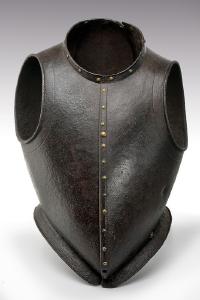
Waistcoat Cuirass circa 1580
Italian. Full peasscod shape mimicing the doublet of the time. Formed in three pieces, one narrow one down the center of the back and two sides which join at the center of the front. The sections are secured by a pair of interior inset hinges in the lower portion of the back. Arm holes with outward turned roped rolls bordered by an engraved line. Neck and waist edges with inward turned finely roped rolls and bordered by single incised lines. The front is decorated with a series of false buttons formed of iron rivets with brass caps, a few of which have lost their caps. The cuirass is secured closed by means of two threaded studs on the interior plate that engage holes on the outer plate. Currently one of these holes is filled with a modern brass bolt. The top edge is formed into a low straight collar, the bottom edge is flared out below the waist. Shot proof thickness with what appears to be a proof mark on the left side. A nice example of a rare type of body armour. Several defenses of this type (etched) survive in the Wallace collection. There are a few plain ones in the Graz arsenal. These are normally thought of as light civilian armours or decorative, but there are several like this one that are definitely designed for protection against weapons used in warfare.
Measurements: Width under the arms 14 in. width at the waist 10.25 in. height at the back from the waist to the top of the collar 16.25 in. Neck hole 6 in. wide and 6.25 front to back. Thickness varies significantly and apparently intentionally. Selected locations on the center back plate are app. .10 in. The shoulders vary between .16 in. and .18 in. Thick spots in the front are .30 in.
Weight: 26 pounds 11.2 ounces (12.114 kg).
Provenance: Peter Finer. Listed in the 1996 catalogue. Previously from the Christies sale Weds 22 July 1992 lot 105 where it is compared to the Cologne-made waistcoat cuirass in the Kienbusch Collection (no. 29)
Not for sale.

Breastplate circa 1580
One piece with deep peascod form. Narrow sliding gussets at the arms. Fauld of two lames. Tassets formed of nine plates. Primary edges formed with inward-turned roped rolls. Secondary edges with single engraved lines. Breastplate and tassets with additional raised and roped ridges on each side. Parts well matched forming a good, coherent look typical of a late 16th c. Italian breastplate, fauld and tassets. Leathers, buckles and rivets replaced. Gussets not quite a pair. These breastplates often have fixed gussets (ones without slots at the upper rivet) and these slots have rounded ends so the slots may be later. The neck roll is very nicely tapered. At the center it is just under 1/2 inch high and it tapers to 3/16 inch at the ends. It is formed with a straight front edge then rounded top face and continues with a round section to the interior edge of the roll. Tasset plates secured by a central interior leather and rivets at the front and back. This arrangement allows the tassets to bend nicely but still keeps the plates controlled. It appears to be the original configuration.
Measurements: Width under the arms 13 3/4", width at the waist 10 3/8", width at the shoulders 10 1/4", height from the center of the neck roll to the base of the peascod straight on the inside 13 5/8".
Thickness of the breast varies between about .050 and .10 inch. It is generally thicker in the upper center and thins toward the edges, upper corner and into the peascod. Tassets .022-.035 inch, the thinnest spot on the left tasset on the outside lowest plate where it would overlap the cuisse.
Weight overall: 8 pounds 12.9 ounces (3395g). The interior is heavily textured from rust and the outside has been cleaned so the original thickness and weight were likely somewhat higher.
Not for sale.

Breast and back circa 1580
Well matched. Probably originally a cuirass. Breast with blunt peascod form at the waist. Inward turned roped roll at the neck. Single fauld lame (small patch on one end, larger patch on the other). Arm gussets lost. Some losses at the upper corners. Each end of the fauld lame with a modern patch, one forming a small end extension, the other much larger. Surface with recessed and raised areas. The raised areas mimic a typical "Pisan" pattern of bands of etching. The raised areas forming a border at the neck, along the arm holes and down the sides of the breastplate and at the neck and armholes of the back. There is no need for a border on the sides of the backplate, these are overlapped by the breast in use. Both breast and back have a central raised band with three three additional bands on each side radiating from the bottom. Raised areas extensively etched (and heavily worn). Matching back plate with matching decoration in similar condition. Neck, arm holes and waist flare with inward turned roped rolls. Etching also heavily worn and with later pair of holes at the center back. One internal riveted patch at the waist. Both breast and back show minor and larger signs of delamination.
This style of raised and recessed bands with etching seems to be relatively rare. A similar breastplate is preserved in the Fitzwilliam Museum in Cambridge (HEN.M.7A-1933) described as North Italian c. 1580.
It appears that the breast has been adapted for later use. The original holes for the gussets and straps at the shoulders have been augmented by a pair of radially decorated studs. These would have been used to secure steel covered shoulder straps that were used in the 17th c. I expect that the gussets were removed at the same time. It appears that many later 16th c. breastplates re-used in the 17th c. had their gussets removed. In addition there is an internally riveted strip at the right shoulder. This seems to be older than the patches in the fauld lame. There is no corresponding crack or hole in the breastplate. It appears that this is part of an originally larger plate. There is an additional rivet lower and the outer edge of the plate extends past the main edge of the breastplate and it seems that it was flared out in front. This may have been one of the odd extensions added to breastplates in the 17th c. that are described as being used to support the stock of longarms. A breastplate which retains one of these plates was found at the Jordan's Journey site associated with Jamestown VA.
Thickness: Breast: generally .08 in. Thins at the neck and around the arms where it would have been worn over a gorget and where the gussets would have added some thickness. Backplate: .042 in. at the waist and up to the arm holes. Thins toward the shoulder blades - .035 in. at the right and .023 in. at the left.
Purchased as part of a lot with A-354, W-59 and W-60 stated to have come from the important private collection of a Rocky Mountain couple. Image shows lot as sold.
Not for sale.

Breastplate circa 1580-1600
Good simple peascod form with integral flare forming a fauld. Inward turned plain rolls at the neck, arm holes and center of the flare between the tassets. Single engraved line at the neck and arm holes parallel to the rolls. Buckles at the shoulder (replaced). Fauld flare carries three straps on each side for the attachment of the tassets. Black rough from the hammer finish (refreshed with paint). Leathers replaced. Marked internally '14' matching the back and tassets.
Not for sale.

Breastplate circa 1580-1610
Central crease ending in a well formed peascod point at the center of the waist. Inward turned and tapered file roped border at the neck with plain inward turned rolls at the armholes. Flared at the waist to carry tassets. Buckles at the shoulders to secure it to the backplate and three straps on each side of the waist flare to carry the tassets. Tasset straps secured with iron rivets and copper alloy rosette washers. Surface rough from the hammer with (likely) later blackened finish. The finish isn't just modern paint. It is at places brown and semi-transparent. This may be an older linseed oil based finish. The buckles and straps are well done, but they appear to be modern. Interior marked with 'IX' matching the mark on the backplate.
Thickness generally .085-.090 inch over much of the surface. Thins at the edges under the arms to .065 inch and to .075 near the neck where it would overlap a gorget. Thickness is also generally thinner at the peascod, but it is also more variable. Weight 5 pounds 8 ounces (2495g).
Not for sale.

Breastplate circa 1580-90
Formed in one piece with one fauld lame. The neck and arm holes are bordered by simple inward-turned rolls. There is a prominent central crease terminating in a point at the waist forming a full, typical peascod shape. The surface is decorated with three pairs of engraved lines on each side. There are (later) hasps on the side to secure the breastplate to a backplate. There is a single (probably later) fauld lame which has rolls at the end and forming a small arched cut out at the center. The interior retains some old red paint and most likely a painted collection mark 'H'.
Height 20 in. overall, 16 12 in. from the center of the neck hole to the bottom of the peascod. Width 15 in. at the bottom of the arm holes, 12 3/4 in. at the waist.
Not for sale.

German Black and White Cuirass circa 1580-90
Comprising a heavy peascod breastplate with roped flanges at the neck and sliding gussets, the lower edge flanged for a skirt of 2 plates, the bottom one arched, turned and roped at the center, and matching three part backplate with separate riveted culet, the edges turned and roped, the surfaces throughout divided by bright bands and borders into blackened panels, rough from the hammer, and struck near the neck on both breast and back with the Nuremberg mark and a maker's mark of a pair of shears in an inverted shield (possibly that of Martin Schneider). The waist belt is an older modern replacement which needs to be replaced again. The shoulder straps are newer replacements. 5 of the 6 straps for the suspension of tassets remain and they are secured by 8 lobed roset washers. Working life leathers are relatively rare, these are a nice survival. The fauld lames are slightly deformed. The right gusset, breastplate and both fauld lames are marked with a chiseled 'X' assembly marks - the left gusset is different - possibly due to its having been for the left (it fits and matches the right in every respect). Identified maker's marks are relatively rare. Makers were qualified in separate armour elements, there appears to have been one who was a master in both breasts and backs in Nuremberg who used a similar mark, so the attribution is probably accurate. The form, material distribution, marks and details indicate that this is a pretty good cuirass. The rolls, roping, recessed bands and 'engraved' lines are all nice. This piece is nicer than many black and white armours. The line terminations at the points are indicative of a pretty aggressive method of manufacture.
Measurements: Breast mostly .090 inch thick tapering at the sides to app. .070.
Not for sale.
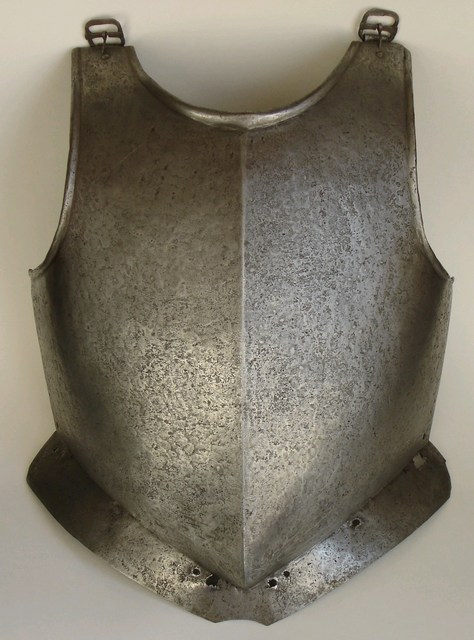
German/Austrian (possibly Gratz) Breastplate circa 1590
Including 2 buckles at shoulders. Rolled edges at arm holes and neck, full flare at waist - used without any fauld lames. Simple peascod shape. This breastplate is relatively light and most likely sword proof and not shot proof. This item is very similar to large numbers of breastplates in the Arsenal in Graz. Its original blackened finish has been removed by cleaning with acid. Originally it would have been used with a pair of tassets suspended directly from the wide flare at the waist of the breastplate - taking the place of the fauld. The holes for the tasset straps are evident. Each tasset would have been suspended by 3 straps and buckles - the ones nearest the edge and center of the breastplate were attached by 2 rivets, the central one with a single rivet. It is interesting to compare this to item number A-209 which is has a very similar form, but make to be shot proof.
Weight 3.5 lbs.
Thickness: rough inner and outer surfaces, but roughly .050-.060 inch thick overall.
Not for sale.
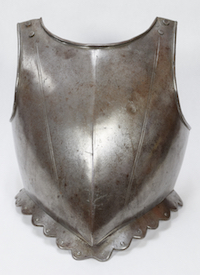
Breastplate circa 1590
Breastplate. Shot-proof breast made for use without fauld or tassets. Good, full peascod form. Heavy weight. Simple outward rolls a the neck and arms with some signs of roping. The material is thick enough that a simple narrow outward fold has been shaped to look like the more usual roll. Scalloped waist flare. Pairs of incised lines. A nice heavy, shot proof breastplate. Jonathan Tavares, curator of arms and armour at the Art Institute of Chicago indicated that this appears to be one of a set of pieces most likely of Flemish manufacture that were used in England as lower end pieces following the ideas from the very high end Greenwich Armoury. Weight 15.5 lbs.
Height 15 1/2 in. from base to center of neck hole. 12 in. wide at the waist, 14 3/8 in. wide under the arm holes.
Thickness. Near the center, app. 1 in. from the crease the thickest point of the breastplate is .285 in. Generally the center is .220 - .260 in. Thins to .185 at the top of the shoulder extensions. Thins at the peascod to .165-.195 in. Central band forming the crease thins aggresively to .160-.195 in. Tapers to .104-.138 at the side under the arm holes.
Weight: 14 pounds 7.6 ounces (6,656 g).
Not for sale.

Breastplate circa 1590
German. Nuremberg. The breastplate has a deep peascod form with sliding gussets at the arms, a fauld of 2 lames, buckles at the shoulders and a roll at the neck. It is decorated by three recessed polished bands with central creases that continue on the fauld lames. The center of the bottom fauld lame is arched with an inward turned roped border. The fauld carries a pair of knee length tassets formed of seven plates which continue the recessed bands from the fauld at the center. There are raised bands on the inside edge continuing the central band from the fauld. The lower edge of the tassets is bordered by a recessed border and a tapered, inward turned and roped roll. The tassets are secured to the fauld by later hinged metal mounts. There are signs of holes for earlier straps and buckles on each side and the center of the tassets with matching holes in the terminal fauld lame. The fauld lames have holes formerly used to secure interior leather straps on each side. Well matched to item number A-218-c and item number A-218-f.
Measurements (in inches):
12 1/4 wide at the waist, 15 wide under the arms 10 1/2 wide at the shoulders with the gussets extended, 12 3/4 tall from the center of the neck roll to the waist at the base of the peascod, tassets 15 long at the center. Thickness .085-.110 in the center (mostly .090-.10) it is pretty consistent between the side bands. It thins to generally .060-080 on the sides with some areas as thin as .050. The gussets are generally .050.
Not for sale.

Breastplate circa 1590
Italian. Of deep peascod form with a roll at the neck and a flare at the waist. Etched in typical Pisan fashion. Gussets lacking. Flare would have originally carried a fauld of (most likely) one lame.
Not for sale.
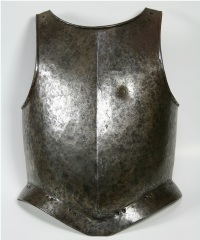
Shot proof Breastplate circa 1600
Simple one piece breastplate with central crease which droops to form a peascod at the waist. Arm and neck holes with simple outward-turned, lightly roped rolls. Flared at the waist. Pierced with holes for shoulder straps at the shoulders and with pairs of holes for three straps on each side to secure tassets. Rough from the hammer finish. Proofed with a musket in the chest. Marked with an unidentified mark resembling '8Z'. Minor delaminations on the outside and some major delamination in the inside near the center of the neck.
Measurements:
Weight: 16 pounds 9.2 ounces. (7,520 g).
Thickness at the center of the bottom half up to 0.340 in. but generally closer to 0.290-0.320, in the top it reaches 0.350 inches near the center, tapering down to 0.250 in. at the shoulder, and down to 0.130 in. at the sides.
Not for sale.

Breastplate circa 1600-20
Augsburg. Breastplate with central crease with a small, but definite peascod at the waist. Inward turned rolls at the arm and neck holes. Single fauld lame secured to a narrow flare at the bottom of the breast by three rivets and formed with a shallow arched cut out at the center. The edge of the arch with an inward turned roll, nicely terminated to align with the tassets. Marked near the neck with Augsburg pine cone mark and maker's mark (a small, crisp HR inside a recessed rectangle) and on the right side with a 9. The breast also has punched marks on the outside that indicate the location of the waist and the center and approximate locations of the arm holes and three notches on the edge of the left side of the inside of the waist flare and matching notches on the right side of the fauld lame. Signs of delamination in various parts of the breastplate.
Not for sale.

Breastplate circa 1610
Etched in the 'Pisan' fashion. Formed of one plate with integral flare at the waist, inward turned rolls at the neck and arms and typical shallow peascod form. Etched overall with seven wide bands of decoration consisting of a central region with figures, trophies and foliage borded by three bands on each side, the central one roped. The central band with two medalions at the neck.
Not for sale.

Breastplate circa 1610
One piece breast with strong central crease terminating in a pinched peascod at the waist. Inward rolls at the arms and neck, arm rolls app. 1/4 in. diameter, the neck rolle larger, tapering from app. 3/8 in. at the center to 3/16 in. at the ends. One fauld lame attached by one rivet on each side and with a narrow arch at the center with a small inward roll. 2 old iron buckles at the shoulder. Interior of the breast (near the neck) and the fauld lame (at the center) marked with two punch assembly marks. Four holes for straps to suspend the tassts.
Measurements 13 1/2 in. tall from the center of the neck to the point of the peascod at the waist, 12 in. wide at the waist, 14 /12 in. wide under the arms, neck hole 7 3/4 in. wide.
Not for sale.

Breastplate circa 1610
Deep peascod form. Plain inward turned rolls at the neck, arms and at the base of the flare. Point relatively flat but drawn out to a narrow point. Holes for rivets along the edge of the flare. Rough from the hammer finish. Fitted with two pegs for shoulder straps and a pair of winged turning pins. Suggesting that it has been refitted for use in more than one configuration.
Measurements: 13 3/4 in. wide below the arm holes, 11 3/8 in. wide at the waist, overall 18 1/4 in. tall. 6 1/2 in. tall from waist to under the arm. Fauld flare 1 3/4 in. long. Thickness .17 in. at the neck, generally .12-.15 in. at the center and tapering to .-08-.09 in. at the sides. The central 11 inches (5.5 on each side) is .1 or greater, varying between .1 and .125 along at line 5 inches from the sides. The thick area near the neck is relatively small, small parts of it are .185. Neck roll .316 tall at the center tapering .2 at the end.
Not for sale.
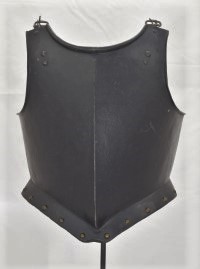
Breastplate circa 1610-20
Black. Heavy shot proof. with good full-form pinched peascod. Full inward turn at the neck tapering toward the ends. Simple flares at the arms and flared at the waist. There are signs of delamination on the inside. Simple buckles at each shoulder. There are additional holes below the buckles which were likely used to secure the backplate in other configurations.
Formerly in the Granscay collection (sold as part of lot 101, Sotheby's European Works of Art, Arms and Armour, Furniture and Tapestries New York - Jan 13 and 15, 1992 - the second item in the lot).
Height 14 in. from the base to center of the neck hole. Width 11 in. at the waist and 13 in. under the arm holes.
Thickest part is at the base near the waist just outside the center on each side where it reaches .240 in. There are very few hammer marks in these thick areas. Generally thins to .170 in. near the edge and .110 - .140 in. at the upper corners and around the arm holes. Mostly .200 to .220 in. in the upper center. Peascod thins at the center (likely from forming the very aggresive crease) to app. .170 in.
Not for sale.
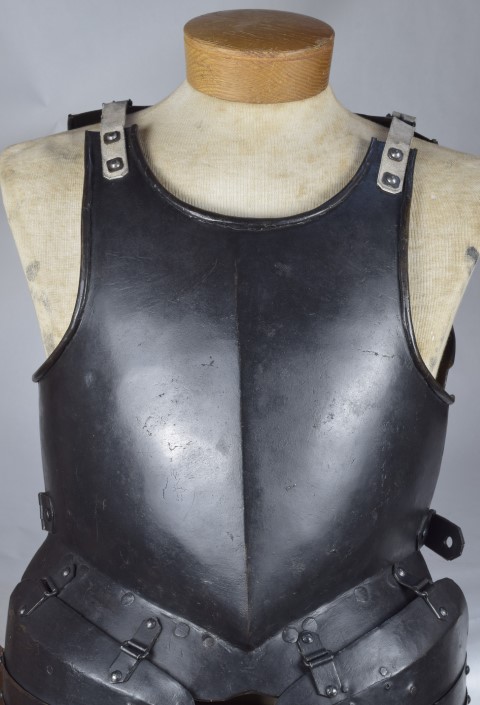
Breast and back circa 1620
Well matched breast and back. Breast with with a central crease extending to a simple, narrow peascod at the waist. The bottom of the breast flared to carry the tassets. Neck and arm holes with simple inward turned rolls. Right side of the breast with a small proof mark. Breast of heavier, shot proof weight. Well matched backplate formed to the shoulder blades and with simple inward turns at the neck and arms, and narrow flare at the waist bordered by a narrow inward turned roll with a narrow recess. Recess bordered by a row of rivets to secure a lining strip. Breast with replaced leather straps at the shoulders. Back with matching rectangular buckles mounted with pointed metal mounting plates at each shoulder. Breast and back secured at the sides by a peg in the backplate and hinged mounts in the breastplate. These are an older replacement for the original waist belt that would have been secured to the backplate at each side at the (now filled) holes.
Not for sale.
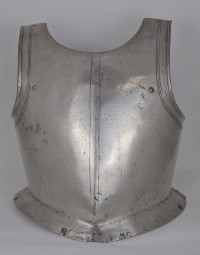
Breastplate early 17th c.
Of simple peascod form. Cut out at the neck without a roll. Inward turned rolls at the arms. Narrow flare at the waist. Formed of two parts, riveted together at the center. Heavy, either shot or siege weight. This is a very interesting piece as it has been constructed from the two main plates of a waistcoat breastplate. We can see the overlap and the larger holes that were likely used to secure the two plates. The line of holes at the sides would have secured the front plates to the side plates. After that went out of fashion, the two parts have been permanently riveted together, the neck cut down and the inner plate recessed so that the overlap is flush on the outside. The arm holes are accented by 3 parallel incised lines and the overlap is made to look decorative - on one side the edge of the front plate is visible, on the other a parallel incised line has been added to convert the line that couldn't be hidden into decoration.
Measurements: Thickness: At the thickest spot on the left of the chest .250 in. Much of the center is .21-.22. Tapers down to .092-.105 at the sides. Most of this taper is in the last 1 1/2 in, probably thinned intentionally because of the underlapping back plates. Tapered in the same way at the shoulders - the left .085 the right .082 but thins out to .05 right at the roll.
Weight 10 pounds 1.56 ounces (4980g).
Not for sale.

Breastplate early 17th c.
Shot proof. Bold turns at the neck and smaller and more even turns at the arms. Medial ridge drawn out to a sharp point. Waist flared to form a short integral fauld. Two hinged pillars at the waist to secure tassets. With two proof marks on the left side. Each of these appears to be made by a ball app. .41" in diameter. This seems small, so it may represent a pistol proof. The inside of the lower mark shows signs of some tearing at the lower edge. This may just be a lamination separating or the material may be close to failure. The roll at the neck is a bold inward turned and very tapered roll. It rises to .68" tall at the center where it is .50" wide. It tapers down to app. .20" tall and a little less in width at the end. The rolls at the arm are turned out and are narrower. The weight, form of the peascod, waist flare, tasset mounting system, rolls - both in appearance and the combination of inward and outward turns - and even the proof marks compare very closely to the breastplate on armour A65 in the Wallace Collection. The catalog dates that armor to 1620 and attributes it to Augsburg. The Wallace indicates that their armor was originally black (like this one) and that it was part of a large group made for the military forces of Bavaria in the early 17th c. Back plate item number A-367 appears to form a cuirass with this piece.
Weight: 11 pounds 1.6 ounces (5040g).
Not for sale.

Breastplate early 17th c.
One piece breast with central crease and a waist that drops at the center of the waist to form a simple peascod form. Integral flare at the waist to carry tassets. Arms and neck with plain inward turns. Buckles at the shoulders to secure the backplate's shoulder straps. Rivets in the flare for leathers to secure tassets (broken). Marked under the right arm on the outside with "154" in a font that seems to be the same as many stamped inventory numbers found on pieces that have come from (or remain in) the Solothurn arsenal. Marked on the interior of the flare with two parallel chisel marks.
Not for sale.

Breastplate circa 1640
Of typical form with small peascod and central crease. Inward turned plain rolls at the arms and inward turned roll over wire at the neck. Small waist flare. Painted on the inside with a 6 in black paint. Marked on the inside with 5 triangular punches and chiseled X. Exterior originally smooth and white. Marked near the neck with a C surmounted by a star. This mark is discussed on page 31 of Thom Richardson's The London Armourers of the 17th Century. It is not explicitly identified, but several possible makers with last names starting with C are discussed on page 30. proof mark on the right side. Lightly oxidized. Earlier varnish cleaned.
Measurements: In the lower center app. .150-.170 in. thinning to .110 in places at the edges under the arms. Somewhat atypically for these late breastplates thicker near the center and thinning pretty evenly toward the edges. The thickness is a lot more even than it is on many pieces.
Weight 8 pounds 1.8 ounces (3675g).
Not for sale.

English Breastplate circa 1640-1660
Simple 17th century form with small peascod point. Neck forming a raised collar (eliminating the need for a separate gorget). Neck and arm holes bordered by an engraved line and inward-turned rolls. Flare at the waist. Signs of 3 marks near the neck. One appears to be the 'A' with something above - most likely the helmet - for the London Amour's Company. The second appears to be the cross of St. George which was used as a government acceptance mark. The third resembles a crude inverted F.
Weight 9 lbs.
Not for sale.
English Breastplate circa 1650
Central crease, flared bottom. Rolls at the arm holes. Neck flared to form an integral collar with rolled edge. Pins for securing shoulder straps. Belt clips. Marked with 'SK' and an 'A' surmounted with a helmet. The 'SK' mark is identified as that of Sylvester Keene in "The London Armourers of the 17th Century" by Thom Richardson. The helmeted A is the mark of the London Armourer's company during the interregnum. The central crease is very crisp and sharp. There are faint signs of a proof mark. The belt loops are forged - the upper part drawn out into a circle, the bottom slightly tapered and with a small roll at the end. The transition is not bent, you can see the thickness of the metal between the top that was drawn out sideways to form the circle and the bottom that was tapered and thinned. The inside is painted with what appear to be 2 large letters, a clear 'E' and the remains of a 'O' or 'C'. There are later internal loops riveted to the inside under the armholes.
Not for sale.
Breastplate mid 17th c.
For use by a Harquebusier. Low medial ridge down out to a blunt point above a short flare. The lower edge, neck and arms with internally turned rolled edges. The rolls at the arms and base with parallel pairs of incised lines. The neck with a short, integral standing collar. Two studs for the straps that would secure backplate. Two studs on the flare. These may be later, or they would be used so secure tassets.
Internally marked in several ways - 44 in red paint on the left under the arm, three round and 5 triangular marks inside the right upper chest, 7 triangular marks inside the right side under the arm and a single notch with a pair of marks forming an inverted V at the right side of the waist. Identified by the seller as having been made for a youth.
Weight 3 pounds 14 ounces (1765g).
Measurements: 32 cm high.
Thickness: generally .090 near the center, .070 near the arm rolls, .050 under the front of the arm holes and .040 at the edge under the arm. The thickest spot seems to be right of center at .1 and there are some very thin spots under the right arm down to about .037. The thickness distribution really seems to be very intentional and pretty evenly done.
Not for sale.
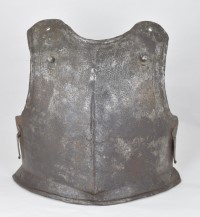
Breastplate mid 17th c.
For use by a Harquebusier. Low medial ridge down out to a blunt point above a short flare. The lower edge, neck and arms with internally turned rolled edges. The rolls at the arms with parallel incised lines. The sides with hooks to secure the waist belt. Identified by the seller as having been made for a youth. Top of shoulders likely trimmed and the neck appears to be adapted from its initial form with an integral collar to be worn as an 18th or 19th c. cuirassier's breast.
Weight: 5 pounds 1.2 ounces (2585g).
Measurements: height 31.5 cm high.
Thickness: Not as carefully managed as some. Generally the thick areas are app. .145 in. thinning slightly to .125 in. in the center and to .10 in. at the edges. There is one area that likely represents a void or internal corrosion that reaches .205 in. thick.
Not for sale.

Breastplate with tassets mid 17th c.
Low medial ridge extending to a blunt point above a wide flare at the waist to carry tassets. Pegs and hooks to engage the terminal plates of straps attached to the backplate. Struck at the neck with a crowned IR mark (James II armoury mark) and armourer's mark "IW" possibly that of Joseph Whorewood or John Wright. For an additional example of the IW mark see item number A-136. Marked on the interior of the waist with X I X formed by chisel marks. Tassets each of one plate embossed to simulate multiple plates. Decorated with rivets. Each secured to the breastplate by a pair of hinges. Well matched to item number A-370-d. The form of the neck indicates that it was designed to be used with a gorget.
Not for sale.
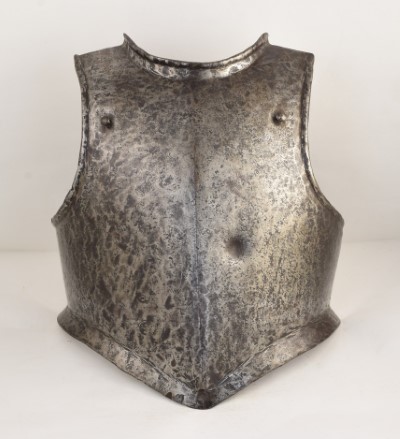
Breastplate mid 17th c.
Breast with short peascod and central crease. Neck drawn up to a short integral collar. Neck and arm holes rolled. Single proof mark on the left side. Studs on each side of the chest to secure shoulder straps on the backplate. Rough from the hammer surface with small amounts of old black finish coated in modern varnish or wax (browning) with some recent oxidation. Significant signs of delamination at the sides. The surface is particularly rough, showing aggressive tool marks at the neck and waist. Marked "WK" near the neck on the right side and double marked with incomplete circular marks lower on the right center. The WK mark is described and illustrated on page 54 of "The London Armourers of the 17th Century" by Thom Richardson. It lists and illustrates the mark on harquebusier's pots (RA II.235 and IV.1603) both dated to 1650 but no maker is identified. The large circular mark appears to be a form of the mark described on page 92. It is found on a large number of pieces and Thom indicates that it appears to be a mark applied to the material on pieces intended to be shot proof. The incomplete marking is typical of this stamp - it is so large that it seems it was usually incomplete. I include an image that shows the piece half cleaned - the viewer's left side has had the varnish removed with cotton cloth and acetone and a light scrubbing with 000 steel wool. This leaves the original surface including the stable black oxide, but removes the modern discoloration and coating.
Measurements: Weight: 8 pounds 23.8 ounces (4020g). Thickness: Generally .18-.185 in the center and tapering through .175 to .150 at the edge under the arm.
Not for sale.

Breastplate mid 17th c.
Breast with short peascod and central crease. Neck drawn up to a short integral collar. Neck, waist flare and arm holes rolled. Single incised line parallel to the arm holes and a single incised line at the neck which drops to a point. Inspection of the interior shows folded over edges at the sides and neck and some holes that only go part way through the breastplate. This indicates that the breastplate is an example of the relatively uncommon "duplex" construction. There is a delamination in the right side of the waist flare that appears to be a section of the outer later that is lost. This style of construction is documented in the article "Duplex armour: an unrecognized mode of construction" by Anthony de Reuck, David Starley, Thom Richardson and David Edge in Arms and Armour volume 2 number 1 - 2005. There are two internal loops riveted into the center of the waist. These are later and likely used to suspend the piece from the wall.
Measurements: Weight: 8 pounds 4.8 ounces (3770 g). Thickness near the center generally .16-.19 in. tapering to .12-.135 at the sides. The central band is about 3" wide on each side.
Not for sale.

Civil War Cuirass circa 1650-60
Composed of reasonably well matched breast and back plates. Breast and back rough from the hammer with inward-turned rolls at the neck and arms of the breast and neck,arms and base of the waist flare on the back. Breast with 2 proof marks, most likely pistol given the moderate weight of the breast and minimal depth of the dents. Breast with several marks. The first is the A surmounted by a helmet used by the London Armourer's company between 1650 and 1660 during the inter-regnum. The others less distinct but probably an R - attributed to Francis Rolenson/Rawlinson - to the left of the crease, the last even less distinct, possibly MM. The inside is marked twice with paint, '219' and what appears to be '9R'. Back marked with a L on the collar and the number 2188 below the right shoulder strap. The L is a common mark on English armours, but not currently attributed. The breastplate is certainly of English manufacture. The back is associated and is probably English. Shoulder plates and waist belt replaced. For more information on armours and marks of the London Armourers see The London Armourers of the 17th Century by Thom Richardson.
Not for sale.

Breastplate late 17th c.
Nearly flat form with central crease. Rolls at the waist, arms and neck. The neck hole is relatively broad and not turned up to form an integral neck protection. The roll at the neck turned out, the rolls at the arms turned in and the roll at the waist turned in over a wire. Proof mark. Studs at the shoulders to secure shoulder straps. Additional pair of filled holes above the current studs. Double incised lines at the arms and neck and parallel to the center crease on each side. Line of rivets at the waist. This may have been made originally in this configuration, or it may have been adapted from a more typical breastplate with a flare at the waist. The neck line is similar to those on breastplates which are designed to be worn with a gorget. Marked near the neck with RH, 30 and a third less clear mark over the RH that appears to be the center and right arms of a crown, the left damaged by pitting. The RH mark (and possibly the crown) showing signs of a double strike. RH with a crown over it is described as the mark of Richard Holden (or Hoden) on page 44 of "The London Armourers of the 17th Century" by Thom Richardson. Atypically, there is a lot of information about him. Richard Holden was made free in 1665, indicating that this piece (if it is his) would have been made after that date. Richard Holden has been identified as the maker of the famous harquebus armour for James II made in 1686 which survives in the Royal Armouries (II. 123). Surface with heavy pitting. After aquisition very lightly cleaned to remove active rust (scalpel cleaned) and remove old varnish or wax coating.
Measurements: Weight: 9 pounds 11.2 ounces (4400g). Thickness: .195-.233 inch in the center tapering to .155 inch at the sides.
Not for sale.

Breastplate 19th c.
This appears to be a breastplate for the Household Cavalry. The lining is 2 layers of canvas stitched to a fabric lining band that is riveted to the breastplate. The lining appears to be marked with B 222, Lance Corporal Robinson, A6 and a date Jan 20th 1855 (the date is unclear - 18x5 seems clear and I think I'm right on the rest of the date.
Not for sale.