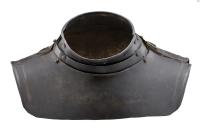
Gorget circa 1510-20
North Italian. Described as composed by the seller who felt that the top two lames were associated. Main plates of wide, squared form for use with a shorter breastplate with a straight upper edge. The outer edge is bordered by two bumps in imitation of rolls, each bordered by single engraved lines. The neck formed of two plates front and back. The upper edge of the main plates and the first neck lame are bordered by a single engraved line. The neck lames secured to the main plates and each other in an atypical manner - with sliding rivets. The top plates with plain, angular inward turn. The upper lame is deformed, which may have led to the assumption of association. All of the plates would fit if the upper one were not deformed and there isn't any sign of re-worked attachment between the plates. Because the plates are secured with sliding rivets, the main plates can not be attached in the normal way (pivot and keyhole). In this case they are not secured at the sides at all. Another interesting detail is that the hinge is on the right and the pin on the left of the upper neck lame. Overall old blued finish with traces of gilding. Very similar in construction to gorget illustrated on plate 188 of L'Arte Dell'Armatura in Italia. This shares the slots, angular roll, hinge on the right and overall form. The illustrated gorget has an additional neck lame, etching, keyholes (but no pivots) on the main plate and is generally a nicer example. This and its related examples appear to be representative of an early stage in the development of the gorget where they hadn't quite worked out the details that would become common later. It is wider than normal, which requires a flatter shape with more room at the armhole for movement. The lack of rivet and keyhole in the main plates makes the thing somewhat unstable until it is secured to the body by the shoulder straps for the cuirass and the weight of the breast and back. Once this is all in place, it appears to function reasonably.
Measurements: Weight 2 pounds 5.4 ounces (1060g). Thickness .032-.057 in. mostly .038-.048 in.
Not for sale.

Gorget circa 1515-1520
Italian. 'Alla Tedesca'. Formed of 2 large main plates, one front and back. Neck formed of 3 lames front and back the uppermost with large, heavily roped roll. The other 2 with closely-set flutes. Main plates with embossed ridge at the outer edge, recessed border, closely set flutes, a wide area with engraved decoration and a narrow embossed, roped ridge at the neck. Front and back secured by integral hinge on the left and pin on the right. Small patches. Leathers replaced. Leathers on one side have collapsed causing the neck to bend over sideways in the images. With good leathers it would sit taller and straight. Previously sold at Sotheby's New York European Works of Art, Arms and Armour, Tapestries and Furniture June 1, 1991 Lot 480. Arms A-128 part of the same lot.
Measurements: 11 in wide at the front and 13 5/8 in. wide at the back.Top roll 6 in. wide and 6 1/4 in front to back.
Thickness .030-.052 in.
Weight 2 pounds 12 ounces (1245 g).
Not for sale.
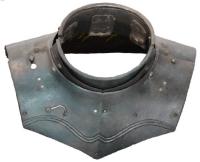
Almain collar circa 1540
Three plates front and rear. Upper plates with inward turned, roped border at the neck (turn at least somewhat of jelly-roll form and fine very angular roping), secured by an integral hinge on the left and pin on the right (there are two holes on the right side, the top one secured to the rear plate and engaging the hole in the front plate). Main front and rear plates with triple raised lines curving up to a central point. Originally part of an almain collar, right side with a turning hook to secure the leather for the right shoulder. Cleaned and re-blacked. Together with (detached) shoulder defense for the left shoulder of 6 plates. The lower plate with an inward turned ropped roll, buckle and raised flutes ensuite with the main plates. All aparently originally finished bright. Collar cleaned, re-leathered and with modern blackened finish. Shoulder cleaned and preserved but not restored. Remains of old leather at the front and center. The center of the front of the gorget and the shoulder creased, edges beveled and notched at the center. Buckle mounted to the front of the lower shoulder plate with a decorated plate. There is a slot behind the buckle which was probably used to secure the end of the strap. The shoulder plates of typical form - the top plate basically flat, the next dished more than the others, the next 3 lightly dished. The bottom plate slightly dished in the back half. The current shape of the shoulder is curled up due to deformation of the old leathers. This does mean that it illustrates how the arm could bend forward in use. From the Armoury of the Princely House of Hohenlohe-Langenburg, removed from Schloss Langenburg. Painted on the inside of the front and back plates of the gorget with inventory number 444.
Weight: 2 pounds 5.4 ounces (1065g).
Not for sale.

German Gorget circa 1550
Formed of 3 plates front and back with additional plates covering the points of the shoulders. Main front plate with central crease. Main rear plate formed to the shape of the neck and shoulders. Neck tof two lames front and back. Upper plates with strong inward-turned roped rolls. Neck lames creased at the center front following the crease in the main plate. Neck lames attached by 3 leathers front and back, each secured by 2 rivets in each plate. Upper plate secured by an integral hinge at the left and a pin at the right. Main plates secured by a pin at the left and a pin engaging in a keyhole slot at the right. Attached shoulder protection of two plates each. One a small articulating plate, the other shaped to cover the point of the shoulder. Edge rolled and roped. Secured with sliding rivets at the back and leathers at the center and front edge. The leather on the right can be detached from the main plate to allow the gorget to be opened. Two hinged mounts for the suspension of the pauldrons, each carrying a vertical pin with a spring-loaded catch. One associated. Older leathers. A pair of holes at the base of the center of the rear main plate. I have added two images of another separate pin in the collection. This one has lost its toggle, but retains its spring.
Measurements: Top of neck slightly out of round. App 6 1/2 inches across on the inside (app. 1/4" longer front to back than side to side). The main plates are 10 1/4 inches wide at the front, 11 1/2 inches wide at the join between the front and back plates and 13 1/4 inches wide at the back.
Thickness: Overall thickness varies between 0.03 in. and 0.050 in. It is generally around 0.040 in. thick.
For similar see WAM 2014.783 - formerly in the John Woodman Higgins Armory Collection and Claude Blair - European Armour - page 207 item 150 - illustrates item II. 1 from the Royal Armouries.
Not for sale.

Munions circa 1550-1600
gorget of 3 plates front and back. The main plates rough from the hammer and blackened with raised crescent decoration on each side. Neck plates polished, upper plate with a bold inward turn. Shoulders of 6 plates the second shaped to the point of the shoulder, the final plate with inward turned roped roll at the bottom. Bottom plates blackened with central raised polished band and terminal plates decorated en-suite with the main gorget plates with raised polished crescents.
Not for sale.

Gorget circa 1560
South German, probably Augsburg. Of bright steel composed of 4 plates front and back. The top one with inwardly-turned and roped roll, the bottom one drawn down to a blunt point in the front. Hinged on the left side with an integral hinge in the top collar plate and a rivet in the main plates. Secured by a rivet on the rear plate engaging a keyhole in the front plate and two pins engaging holes in the upper plate on the right. Two pins are relatively rare. This may be to keep the upper plates aligned perfectly if the collar is meant to engage a roll on the bottom of the helmet. The upper one is secured to the rear plate and engages a hole in the front plate, the lower one is secured to the front plate and engages a hole in the rear plate. The top corners of the second rear plate are notched to allow the gorget to open, the plates to fit nicely and still allow for an overlap. With brass-capped rivets throughout. The rivets that secure the straps for the pauldrons are modern. The other rivets may be original, which would make the leathers original. Possibly some form of mark on the main front plate. Very nice form with tapering neck plates. The gorget includes two straps for securing the pauldrons which appear to be later replacements. Details of the contruction including the difference in thickness between the front and back plates, the double pins, beveled edges, inset hinge, brass capped rivet heads and finished edges of the inner plates indicate this likely formed part of a high quality armour. This is very similar to the gorget on Wallace A45 catalogued as A45.02 and WAM 2014.1175.2 formerly in the John Woodman Higgins Armory Collection. The leathers are old and collapsed so the images do not show the plates sitting as they should. The gorget should be much taller.
Ex. Coll. Peter Parsons (2011), Robin Wigington (1977), Part of a South German armour sold by Sotheby , Co. London 12 Feb. 1974, lot 172.
10 3/4 in wide at the back, 8 3/4 in wide at the front. Thickness varies on the front main plate between 0.070 in. and 0.095 in. It is generally in the 0.080 in. range. The main rear plate is thinner - 0.040 in. to 0.055 in, mostly .040-050.
Weight: 2 pounds 8 ounces (1,130 g)
Not for sale.

Pair of Munions circa 1560-1590
Black and white form with raised bands. Gorget of 2 main plates. Neck plates missing. Integral shoulders of 6 plates (top plate on the right missing). The second plate from the top shaped to the shoulder and the bottom plate shaped to the elbow. The raised band decoration along the primary edges formed in an arc. Center and edge bands of the usual straight form. Leathers broken.
Not for sale.

Gorget with munions circa 1560-90
German. Unmarked, but most likely Nuremberg. Black with polished recessed bands at the borders. Decorated with two narrow recessed grooves at the center of the front, back and down the center of each shoulder. Collar formed of 3 plates front and back. The lower plate coming to a blunt point at the front and back. Outer edge with a recessed band with raised border. The upper plate with a pronounced plain inward turned roll. Hinged at the left with an integral hinge and secured by a pair of pins at the right. Shoulders of 7 plates. The second plate shaped over the point of the shoulder. The terminal plate with an iron buckle and mount to secure the strap around the arm. The collar plates are secured by three leathers front and back, each secured to the plates by two rivets in each plate. The shoulders have a row of sliding rivets at the back and two leathers (center and front). The rear of the spaulders is secured to the gorget by a short leather strap. Recessed bands lke these are normally associated with Nuremberg. Blackened surface of modern paint, all rivets, leathers and neck pins replaced.
Not for sale.

Almain collar late 16th c. and later
Very typical munition form. Consisting of a gorget plate front and back with shoulders on each side of 6 plates. Main plates with raised integral collar. Plain inward turned roll at the neck. Shoulders of 6 plates each, the lower one with a roped inward turn at the elbow and recessed border rising to a central cusp. The shoulders have the typical form - a narrow top plate, a larger more shaped shoulder plate, three relatively straight plates and a terminal plate formed to the elbow. Terminal plates with buckles at the front and straps at the back to secure the armor around the arm. Black rough from the hammer finish (refreshed with paint).
This is an interesting example of 'restoration.' One shoulder appears to be late 16th c. The bottom two plates of the other shoulder match. The upper plates of that shoulder are reasonably well made modern plates. The central gorget plates are less well made simulating a very low end 17th c. piece. All of this doesn't look bad when displayed as part of a half suit, but it isn't right and shouldn't be used as example. The overall matching modern paint helps to blend the disparate pieces together.
I have provided interior images to help to show what is going on here. The first detailed image shows the inside of the right shoulder. Here we see the expected hammer marks, signs of oxidation and flaking of old finish and a more modern paint overall. The washers and rivets at the back are consistent - until we get to the final one that connects to the gorget. Here the washer is smaller and just has a different look. We also see that there is another hole next to the top of the slot. The leathers look good, but there are newer pieces patched into the end. All of this tells us that the shoulder is probably good, but it has been attached to the gorget recently. The unfilled hole at the top back is because the typical way to secure a shoulder to the gorget in an almain collar is with a small leather. These are often replaced by rivets later because it is easy, or it seems to make sense. At this point we have a good feel for the shoulder, but know that something has happened with the gorget. Since this is the spot that tends to tear out first, this might just be a repair.
The next image shows the inside of the left shoulder. Here we see a big difference between the condition of the two terminal plates and the other four. This tells us to look more closely. Next we see that the leathers are different from the ones we see in the other shoulder. These feel more modern, the rivets are definitely more modern and they have not torn out between the shoulder and the gorget, so they are probably recent work. Looking at the four upper plates, they mostly have good shape but there aren't any signs of overall hammering or damage from age. We also see that there isn't any sign of a second hole at the back of the top plate and the upper edge of the top plate is slightly flared. All of this indicates that the upper four plates are modern. If the only thing that lept out at us were modern leathers, that would be fine. But there is a lot more here.
Next we see the inside of the back plate of the gorget. There are hammer marks, but they don't cover the surface and they appear (mostly) to have been done onto a soft surface (the round dents) or onto or over an edge (long straight lines). There is also no sign of oxidation. This looks like a piece of modern rolled steel that has been minimally hammered into shape. The inside of old armor just doesn't look like this.
Finally we see the buckles. The one on the right (old and complete) shoulder looks like an original buckle. The one on the left is not bad. It is mounted on a well made plate, but it is a modern buckle (which appears to be placed backwards).
Playing around with the piece on a stand and comparing it to other collars I can also see that the main gorget plates are not wide enough to work correctly. The size doesn't allow the second lame of the shoulder to sit at the point of the shoulder as it should. So you end up with the shoulders bending farther down and not sitting right.
Not for sale.

Munions Late 16th c.
Consisting of a gorget of three plates front and back and shoulders of 6 plates. Gorget secured at the left by an integral hinge in the upper plate and a pivoting rivet in the main plates (pivot with a short slot). Secured at the right by a pin in the top rear plate engaging a hole in the front top plate and a keyhole in the front main plate engaging a peg in the rear plate. Upper neck plate with inward turned roll rolled onto itself like a "jelly roll." Main plates formed to the shoulders and neck. Right side with a keyhole in the front plate for the front shoulder leather. Shoulders formed to shoulder and arm. Central crease. Terminal plate formed to the elbow and with a plain inward turn at the end. Rectangular buckles formed from wire secured to the front of the terminal plate with iron plates. Extensive pitting. Leathers broken and lost. Shoulders secured at the front through the construction rivet holes with modern solid rivets. Details of construction including the integral hinge, slot at the pivot, roll style and form of the shoulders indicate that originally this was a nicer, higher end piece.
Not for sale.

Pair of Munions late 16th c.
Consisting of a gorget of one lame front and back (neck lames lost) and integral shoulders of 6 plates each. Main plates secured by a pivoting rivet on the left and a keyhole slot engaging a stepped rivet in the right. The front plate coming to a blunt point at the center. Rear plate cut straight. Securing mechanism for the right front leather is a sneck hook that engages a hole in a pin secured to the end of the leather (lost). Main gorget plates show signs of working life rework - interior shows the remains of black and white bands. The shoulders heavily tapered from the gorget to the terminal lame. The second plate almost stepped in the front to start the taper, but it continues through the other plates. The shoulders with replaced sliding rivets at the rear and 2 replaced leathers (center and front). Buckles secured by external mounting plates to the front of the terminal shoulder lames. Terminal lames with a inward turned plain roll on the bottom edge. The shoulders appear to be associated as they were never black and white. Old inventory number "2009.6.67" in orange/red paint on the inside. All of the parts appear to be original, but the associated shoulders were added recently to complete the look of the piece. As purchased the shoulders are secured with rivets to the rear gorget plate. Originally this should have used a short leather.
Not for sale.

Gorget late 16th
Two pieces front and back. Single neck lame front and back. Neck plates seem to be associated. The main plates formerly part of a pair of munions, shoulders lost. The main plates originally rough from the hammer and black, since cleaned. The neck lames polished smooth and bright. Integral hinge on the left and stepped pin closure on the right. The outward turned plain roll at the top of the neck lames is another example of the "jelly roll" construction where the material is rolled over itself.
Not for sale.
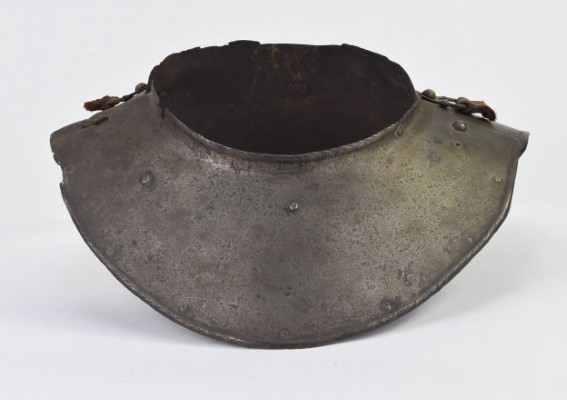
Gorget late 16th c.
Italian. One piece front and back. Neck raised to form integral collar. Neck lames lost. Bump (half rolls) at the neck and outer edge. The half rolls are roped. Some losses.
Not for sale.

Gorget circa 1570-1610
Etched in the 'Pisan' fashion. Typical Italian straight necked form. Formed of 3 pieces front and back, the main plates with a rolled lower edge and flared at the neck to match the neck lames. Main plates joined by a rivet on the left and a pin engaging a keyhole slot on the right. Upper neck lames joined by a hinge on the left and a pin on the right. Neck plates associated and etched to match. Originally the plates would have been attached with three leathers front and back, now riveted through leather and false rivet holes.
Not for sale.

Italian Gorget circa 1580
Gorget of two main plates with single neck-lames at the front and rear. The outer edges of the main plates are bordered by a half roll and recessed border, the half roll roped. The neck edge of the main plates with matching roped half-rolls. The neck plates with roped full rolls. The neck plates are secured by an internal hinge at the left and a pin in the rear plate engaging a hole in the front plate on the right. The main plates are secured by a turning hook on the right which engages in a keyhole slot. Very similar to that on Corselet II.47 in the Royal Armouries (illustrated on plate LIX in European Armour in the Tower of London). The large round rivets are replacements, likely from a 20th c. refit. At the time the upper neck plates were secured to hte main plates using the holes intended for leathers and the outer false rivet. The left side of the main plates have holes which would have been a pivot. Since the piece no longer has leathers, this allows the gorget to open. The hinge securing the neck plates on the left appears to be a replacement, likely from the same restoration as the large headed rivets. Displayed as part of item number A-114.
Measurements: Top of collar 6 in. wide and 6 3/16 in front to back. 11 1/4 in. wide at the widest part of the back. Thickess of the main plate generally .030-.040, the collar plate .020-.030. Weight 1 pound 9.6 ounces (725g).
Not for sale.
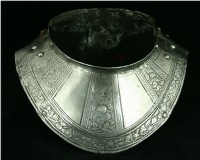
Gorget circa 1580
Composed of a single plate front and rear of rounded form. Decorated with etched cabled bands filled with trophies-or-armour in the style typically described as 'Pisan'. Patches at the ends of the front plate at the pivot and closure. Originally would have had an additional pair of small neck plates.
Not for sale.

Munions circa 1590
German. Nuremberg. The gorget is formed of two main plates front and back. These are formed to the shoulders, the upper plate tapers to the neck. The upper edge of the neck plates has a flattened inward turn. Munions of seven plates are attached to each side. These have a recessed and creased band at the center and a raised band at the front. The terminal plates are bordered by a recessed border and a an inward turned rolled and ropped edge. The intersection between the recessed border and central recessed band is decorated by a point formed in the border recess. The upper two lames appear to be associated and are possibly modern.
Not for sale.

Gorget circa 1600
Gorget. Formerly part of a pair of munions. Formed of 2 plates, one front and one rear, attached by a rivet on the left and keyhole on the right. Smooth finish. Rolled edge at the neck hole. Neck hole unusually wide with almost no rise at the neck. Originally part of a black and white munion (signs of the bands are visible on the inside and traces on the outside). Thje form of the neck and location of holes including in the roll indicate that this piece has undergone some interesting changes during its life. My guess is that the changes were working life since there is no good reason for a collector or dealer to change things this way. Originally this piece would have had neck lames - either 2 or 3 each front and back. Likely when the decorative bands were bashed out, the upper lames were lost and the upper edge of the main plates were rolled. This would have turned a reasonably nice mid to late 16th c. gorget into a pretty crude 17th c. gorget.
Weight: 1 pound 13.2 ounces (820g).
Not for sale.
Gorget circa 1600
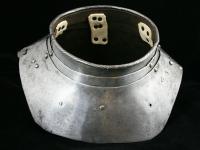
Formed of one large main plate front and rear with two neck lames front and rear. The upper neck lame with an inward-turned rolled and ropped upper edge. The upper plates secured by an integral hinge on the left and a pin engaging a hole on the right. Expertly releathered with buff leather. Temporarily secured to item number A-76 forming a good, low end pair of munions. Now displayed together as part of item number A-161.
Not for sale.

Munions circa 1600-20
Augsburg. Munions of one plate front and back the upper edge rolled at the neck. Shoulders protected by five lames formed to the shoulder and arm and the last extending at the back to form to the elbow and with an inward turned rolled edge. The right shoulder associated. The main front plate coming to a deep point and with an aggressive central crease. One set of shoulder plates creased at the center, the other plain. The central front plate chiseled with the large inventory number 37.
Not for sale.

Munions circa 1610
two piece collar with five piece shoulders. Collar comprising main plate front and rear raised to form an integral neck protection with inward turned plain roll, pointed front-plate hinged on the left and retained by a stud and a keyhole slot on the right, and with spaudlers of five downward-lapping lames, the bottom lames each with turned and roped border. The shoulders are well shaped to the body, broadening out at the top 2 lames. As is typical, the top lame is relatively narrow and flat, the next one larger and shaped to the point of the shoulder, the next two are nearly flat and the last plate is cusped in to fit to the arm. Appears to have originally had a bright polished surface. Signs of the rough grind or file work remain on many plates. There are a number of similar pieces that have come out of the Solothurn arsenal that have survived in very good condition. The grind marks on this piece may show how the piece was originally finished. Shoulder plates secured by sliding rivets at the rear and leathers at the center and front. Shoulders attached to the gorget with a short leather strap at the back and extensions of the central and front leathers. The right side can be removed from the gorget to allow the piece to be put on. A slot in the end of the leather engages a rivet head on the inside of the gorget. Leathers and buckles replaced. Some signs of remnants of older coatings that helped to maintain the material. All parts fit well and are likely original to each other even though the rolls at the base of the shoulders are roped and the neck roll is plain. The gorget on this is very similar in form to that on item number A-363.
Not for sale.
Pikeman's Gorget circa 1620
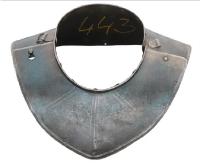
Of single hinged plate front and rear, secured by a rivet on the left side and a keyhole slot engaging a rivet on the right. Low collar with a very narrow outward turned roll and hollow roll at the outer edge. Lining rivets with flush outer heads along the lower edge and along the neck. Decorated with light incised lines. Cleaned and re-blackened. From the Armoury of the Princely House of Hohenlohe-Langenburg, removed from Schloss Langenburg. Painted on the inside with inventory number 443.
Weight: 1 pound 14.8 ounces (870g).
Not for sale.
Gorget circa 1620
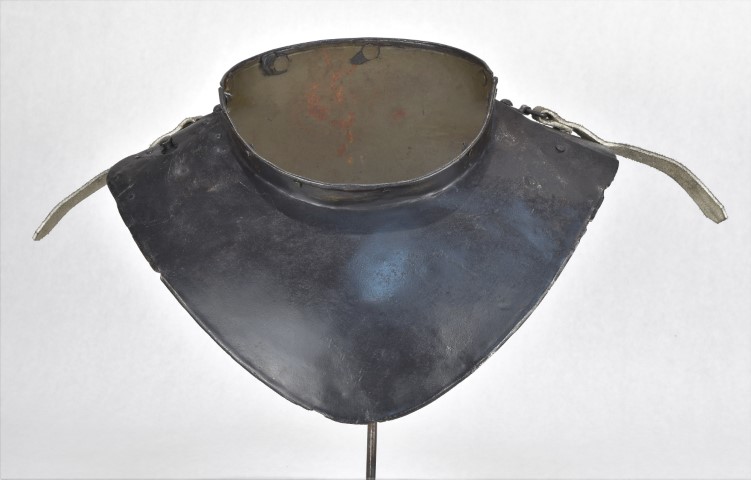
Formed of a single plate front and back with a low extension at the neck. Top edge of the neck with a simple inward turn. Large front plate extending to a rounded point. Lower edges of the plates with simple bumps simulating a roll. Plates secured by a rivet on the left and keyhole slot and peg at the right. Right side with older and new repairs to stabilize the keyhole and peg. Carries a pair of steel plate mounted rectangular loops to secure the straps to which the pauldrons are buckled. Straps new. One mount likely new. Other mount?
Not for sale.

Front plate of a Gorget circa 1620
Probably French. Originally part of a gorget that would have had one plate front and back. The gorget would have been worn without a breastplate - it extends down the chest and it has a full roll at the edge. This would have formed the front of the gorget. The single plate is flared to form a short integral neck protection and it extends down over the chest. The neck and outer edge have a narrow, straight, plain inward turned roll. The outer edge has a parallel raised ridge. The front is decorated with a spray of 6 embossed, tapered bands that end in blunt points. Each is engraged with five lines. The neck, ends of the bands and outer border are decorated with sets of three copper alloy capped rivets. This style of decoration with rivets is typical of the 17th c. This style of gorget was normally worn over clothing or a buff coat and without a breastplate.
The piece is very small. It was likely made for a child. The final image shows it with a full sized gorget to be worn in a similar manner.
I have found a gorget displayed with an armour for Louis XIII (inv. G.123 in the Musee de L'Armee) dated to app. 1630 which is decorated in a very similar (but definitely not identical) manner. The gorget is displayed worn over the breastplate. This is atypical, but given the decoration on the gorget understandable. It also has a longer form and full roll at the border so it is possible that this piece might have been worn with a breastplate in the same manner.
Not for sale.

Gorget early 17th c.
German. Formed of one plate front and rear, each flared at the neck to form a narrow collar. Outer edge and neck with plain inward-turned rolls. The neck bordered by rivets with flush external heads securing a leather band in the front (the band is lost from the rear plate). The front plate is much longer than is usual, this gorget was intended to be worn without a breastplate - either with a buff coat or over civilian clothing. The outer edges are bordered by brass capped lining rivets securing piccadills of crimson velvet bordered by gold thread. Some losses to the piccadills, esp. to the right rear. Lightly pitted and patinated. These early 17th c. gorgets designed to be used without other body armour are discussed on page 56 and illustrated on page 57 of Harnisch und Helm, a book on the subject of the Graz arsenal. This is an example of what they say was called a French ring collar which is described as having been made for officers. This gorget shares the particular features, being extended in the front and surrounded by a velvet border.
Weight: 2 pounds 12 ounces (1245g).
Not for sale.
Gorget early 17th c.
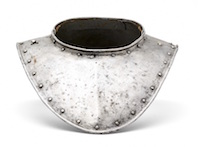
German. Possibly Nuremberg. Rough from the hammer. Rolled neck and outer edge, both bordered by rivets carrying the remains of leather bands. Shape original. Signs of later enhancement by the addition of engraved bands with patterns. These are light, surface lines. This is likely a minimal example of a gorget designed for wear without a breastplate. The most aggressive form of this style is illustrated by item number A-261.
Weight: 1 pound 11.8 ounces (785g).
Not for sale.

Gorget early 17th c.
German. One piece front and back with integral raised collar. The front plate with a shallow crease at the center, the rear shaped to the shoulders and neck. Plates secured by a pivot rivet on the left shoulder and a large keyhole engaging a broad headed rivet at the right. Neck and outer edge with plain inward turns bordered by round head lining rivets with round internal washers securing a lining band. Many of these washers incomplete - they appear to have been punched to close to the next washer, so they have rounded cut outs. Band around the outer edge nearly complete. More loss from the band at the neck. The ends of the rolls on the rear plate crudely flattened at the edges to allow for the overlap of the front plate. Finish appears to be an old very rough "white" finish which shows significant pitting in some areas. Various areas of delamination. The front plate is marked with round center punch like marks. Three of these define the neck line, one at each end and one in the center. There is a fourth mark that defines the center line. There is one similar dot at the bottom center of the back. This is likely a minimal example of a gorget designed for wear without a breastplate. The most aggressive form of this style is illustrated by item number A-261.
Weight: 1 pound 12 ounces (795g).
Not for sale.

Gorget early 17th c.
Formed of one plate front and back each flared at top to form integral protection for the neck. Plates secured on the left by a rotating rivet and on the right with a keyhole in the front plate engaging a button peg on the rear plate. Upper edge of the neck and lower edge with simple full inward turned rolled border. The neck has a line of holes which would have originally contained rivets to secure a lining leather (four remain in the rear, three in the front). There are buckles secured to the rear plate to connect pauldrons. The surface is rough, showing signs of extensive oxidation. There are two cracks in the edge of the rear plate. The front of the front plate (longer than typical and extended to cover more of the chest) and the use of a full roll indicate that this was likely originally designed to be used without a breast and back. For other examples of this style of gorget see item number A-261, item number A-289 and item number A-290.
Thickness: .038-.058 inch. Weight: 1 pound 15 ounces (880g).
Not for sale.

Munions early 17th c.
Gorget of single plate front and back rising to an integral collar. Top of collar with plain inward turned roll. Front plate with central crease and extending to a blunt point. Rear formed to the neck and shoulders. Plates connected by a pivoting rivet on the left and button engaging a keyhole on the right. Two apparent but currently unidentified marks, one on each side of the crease near the point. The one on the right appears to be a shield, the one on the left is smaller. Shoulders of 6 plates. Formed to the shoulder and arm with central crease. Upper plate narrow and flat, second dished more than the rest to form the shoulder transition. Terminal plates fitted to the elbow and with a plain inward turned roll at the edge. Plates secured by sliding rivets at the back and leathers at the center and front. Leathers aging and cracked in some places. Each shoulder terminal plate with a buckle with iron mounting plate at the front. The mounting plates with rounded ends and stamped with a line of decoration parallel to the edge. Right side of the front gorget plate with a T shaped hole to secure the front of the right shoulder. Mounts on the shoulders. These are often added or replaced. They can be made to keep the cuirass shoulder straps in place or to secure shoulders. These appear to be the first style. The mounting plates securing the pegs and securing them to the gorget match the buckle mounting plates.
When purchased the shoulders had separated from the gorget due to broken leathers. The rivets on the gorget and top shoulder plates were removed and the shoulders secured to the gorget with new (short) leathers. The pictures show the first re-assembly where the leathers are secured by bolts.
The form of the gorget is very similar to item number A-292.
Not for sale.

Pair of Munions early 17th c.
Gorget constructed of a single plate front and back. The front plate with a central crease. The bottom edge pointed at the center. Rear plate formed to the shoulder blades. Neck of the plates flared to form an integral collar. Upper edge of the collar with a plain inward turn. Two plates joined by a pivoting rivet at the left and a pin engaging a keyhole slot on te right. Matching shoulders of 5 plates each. The bottom plate with a plain inward turn on the edge. Each with a buckle at the front. The top plate of the shoulder relatively flat, the next more rounded to mimic the point of the shoulder. Shoulder plates secured to each other by sliding rivets at the back and internal leathers at the center and front. Shoulders secure to the gorget plates with three leathers - two to the rear gorget plate, one to the front. The leather on the right front can be detached - it is secured to an internal rivet with a large flat head that forms a button. Overall rough from the hammer with an old black finish. The edges of the shoulder plates and gorget main plate decorated with parallel incised lines. Leathers broken.
Not for sale.

Gorget early 17th
One piece front and back. Neck raised to form integral collar. Losses and modern patches. It appears to have signs of possible bands of decoration which have been mostly hammered out and the neck roll of the front has been flattened.
Not for sale.

Gorget mid 17th
Gorget. Rough from the hammer. Formed of a single plate front and back with inward turned rolls at the neck and outer edge. Secured by a pivot on the left and a pin and keyhole on the right. Displayed as part of item number A-1.
Not for sale.

Gorget mid 17th c.
One plate front and back. Each plate flared at the neck to form a short integral collar. Plain inward turn at the neck. Lower edge with an inward turned roll with a parallel recessed border. The front plate drawn out to a point at the center. Rear plate more rounded in form but with a small point at the center. Each plate internally marked with chiseled XX marks to show the matching pieces.
Not for sale.

Gorget 17th c.
formed of one plate front and back with integral raised collar. Plain inward turned rolls at the neck and outer edge. Likely for use without a breastplate. Losses, later patches and front and back likely associated.
Not for sale.
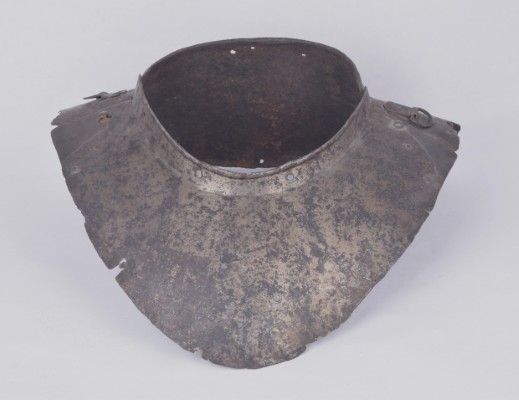
Gorget 17th c.
one plate front and back. Each plate extending up to form an integral neck protection. Plain inward turned roll at the neck. The form of the front plate which extends relatively far down the chest indicates that it was likely intended for use without a breastplate. Several losses and modern internal patches.
Not for sale.
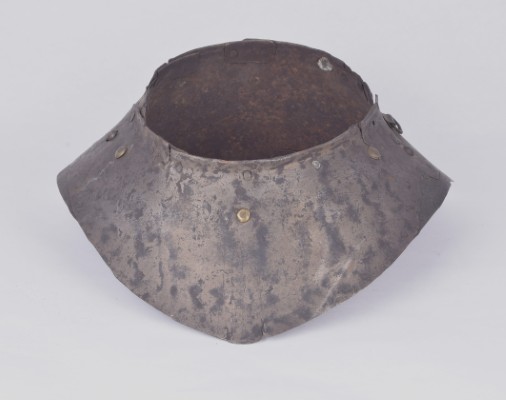
Gorget 17th c.
One plate front and back. Neck flared to form an integral collar. Several modern internal patches. The plates appear to be original gorget plates but they have been deformed/curled - probably in an attempt to mate plates that were not originally associated - so the form is more conical than it should be.
Not for sale.