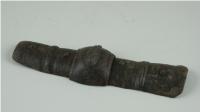
Gauntlet finger circa 1370-1400
English. Three finger plates from a fourteenth century English gauntlet, most likely an hourglass gauntlet. Comprising the first, knuckle and second plates. Main plates decorated with raised ridges at the center bordered by pairs of engraved lines. First plate with slightly domed areas at both ends bordered with a lightly engraved line. Third plate with a slightly domed area at the front that is bent down slightly. Knuckle of domed form with a raised ridge the edges with an engraved line parallel to the edge with plain file decoration like simple roping. Each plate with two rivets to secure them to the foundation arranged down the length of the main plates and on the sides of the knuckle plates. Made of iron. Old, mostly stable oxidized finish on the exterior. Found at Queenhithe, London.
Publications:
- Object and Economy in Medieval Winchester Martin Biddle (Fig 349)
- Medieval Artifacts Nigel Mills. (Fig 245b)
- Armour of the English Knight 1400-1450 by Tobias Capwell page 166 - illustrated along with several separate gadlings in private collections.
Measurements: First plate 2 3/32 in. long, 1 3/32 in. wide at the back end, 7/8 in wide at the front (measured at the very end before the corners are beveled back). Knuckle 1 3/16 in wide, 31/32 long at the side, 15/16 at the center. Third plate 1 3/4 in. long, 1 in wide at the back and 7/8 in wide at the line demarking the shaped area at the end where it starts tapering more. All width measurements performed flat under the curved plates. Thickness: generally .040-.050 with some thick spots up to .060 in.
Weight: 1.2 ounces (30g).
Not for sale.
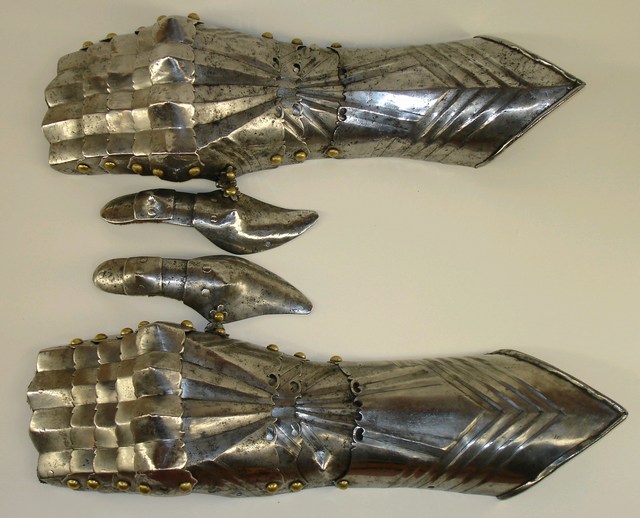
Gauntlets circa 1480-90
Gothic Gauntlets. Nicely formed 'Gothic' gauntlets typical of the late 15th century in Germany. Fluted, engraved and pierced overall. Formed of a large metacarpal plate joined to a wrist lame by another, smaller lame. The cuff is also attached to the wrist lame. These plates are attached with sliding rivets allowing the wrist to flex in all directions. The knuckle plate is formed into a blunt point over each knuckle. The fingers are covered by 4 articulated plates fluted over each of the fingers. These gauntlets have been cleaned and re-assembled, but they are basically a complete pair of gauntlets. The thumbs have been restored and the left cuff is associated.
Weight: right 14 ounces (400g), left 13.2 ounces (370g).
Thickness varies .020-.033 in. Generally thinner in the cuff and back of hand.
Measurements: 14.75 in. long with the slots extended, 13.875 in. long with the slots collapsed, 12 in. from the point of the cuff to the knuckles (with the slots extended and the hand drooped), 5.125 in. from the knuckles to the end of the fingers (with the fingers fully bent), 3 in. wide at the wrist, 4.875 in. wide at the knuckles, 3.56 wide aat the end of the cuff, width of the fingers at the rivets on different plates tapers from 3.875 in. down to 3.625 in. All measurements on the right gauntlet.
Not for sale.
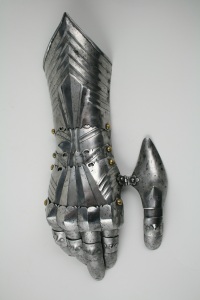
German Gothic Gauntlet circa 1480-90
Single gauntlet for the right hand. Nicely formed 'Gothic' gauntlet typical of the late 15th century in Germany. Fluted, engraved and pierced overall. Formed of a large metacarpal plate joined to a wrist lame by another, smaller lame. The cuff is also attached to the wrist lame. The cuff is pointed with a small outward turn. The knuckle, metacarpal, wrist and cuff plates are attached with sliding rivets allowing the wrist to flex in all directions. The knuckle plate is formed into a rounded crease over each knuckle. The base of the thumb is covered by a large plate secured to the metacarpal plate with a hinge. The thumb and fingers are covered by two plates bridged by a pointed knuckle plate that overlaps the other two plates. The finger plates are secured to a plate inside the knuckle plate. This plate is secured to the sides of the knuckle plate. Rivets replaced. Finger and thumb plates are probably also modern, but well made.
Thickness: cuff generally 0.028 in (varying, .025-.032), wrist plate and next hand plate app. .030, main hand plate .030-.055 - mostly .040-.050, knuckle plate can't reasonably be measured due to the inner plate and finger plates.
Weight: 13.2 ounces (375 g).
Exhibited: Feb. 10 2023-Feb. 29 2024 Orange County Historical Museum Hillsborough NC
Not for sale.
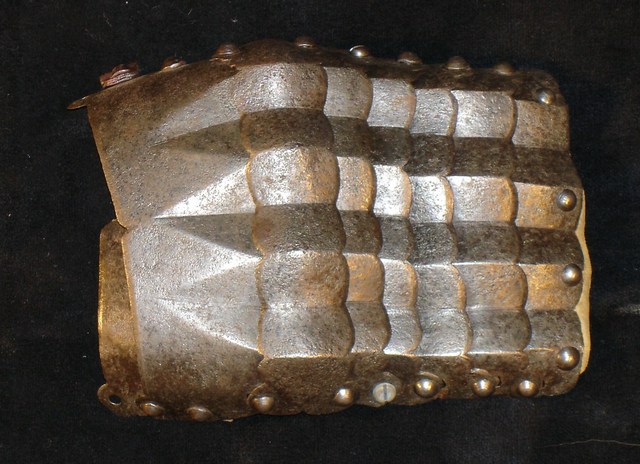
German Gauntlet (part) circa 1490-1500
Finger, knuckle and 1 1/2 metacarpal plates of a German Gothic mitten gauntlet. The finger lames are fluted to simulate fingers, the knuckle plate with rounded and creased knuckles. The first metacarpal plate is fluted with v-shaped puckers to accommodate the flutes in the knuckle and finger lames. There is half of the hinge used to attach the thumb plate, and half of the second metacarpal plate remaining. Each of the articulations is formed with sliding rivets with slots app. 1/4 in. long. 2 rivets have been lost, the parts held together by bolts. Formerly in the collection of Leonard Heinrich - armourer to the Metropolitan Museum of Art, NY.
Thickness: Generally around .030 in. The back of hand plate is pretty consistently .028-.032. The knuckle plate varies more, generally .025-.030, the finger plates vary even more - .020-030. The hinge is folded over. The overall thickness of the two layers is .060 at the bend, the actual metal is likely a little thinner. The pin is .090 in diameter, the hinge is .450 wide at the pin. The partial plate is 3/4 in. wide at the center, .7 in. at near the bulge at the end, .85 at the bulge for the rivet. The second finger plate is just over 1 in. wide. The first plate is app. 1 1/16 in. wide. The main hand plate is 2 in wide at the first knuckle tapering to 1 11/16ths at the fourth knuckle.
Weight: 4.6 ounces (130 grams)
There are often questions about how the flutes can work through the range of movement, esp. where the knuckles interact with the metacarpal. The last two images posted show the interaction between the metacarpal and knuckle plates when the hand is straight and when the sliding rivets are fully compressed and fully extended. These show that they really don't work all that well when fully compressed and straight. They do look and work pretty well when somewhat bent and extended. This is just sort of the nature of movement when one plate has tapering flutes.
Not for sale.
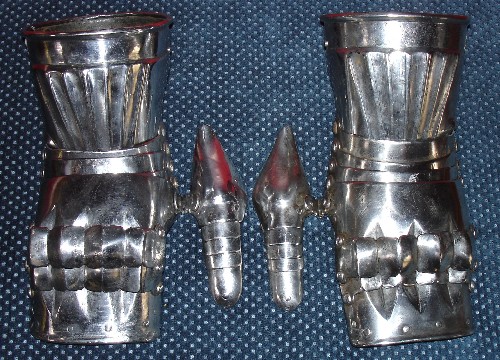
German Gauntlets circa 1510
Gauntlets of steel. Very early 'Maximilian' form. Narrow cuff of close-fitting form. Inner plate opens on a hinge and spring-pin. Recessed border and simple spray of flutes. Metacarpal of 3 narrow lames and one larger lame near the knuckles. Knuckle plate formed with a rounded ridge over each knuckle. Base of the fingers covered by 2 mitten plates. The large metacarpal and final finger plates are fluted in a 'V' to fit to the knuckle plate. The base of the thumb covered by a plate hinged to the main metacarpal plate. Remainder of the thumb covered by a series of overlapping plates rivetted to a leather base. The form of the finger covering is a simple form that would have been used in lower quality or infantry armours. The main form of the gauntlets is similar to the pair of gauntlets on a harness in the Waffensammlung of the Kunsthistorisches museum in Vienna - illustrated on plate 104 (harness described on page 228-9). Cleaned. Small thumb plates, rivets and most leathers restored.
Weight: right 1 pound 3.0 ounces (545g), left 15.0 ounces (425g).
Not for sale.

Two Gauntlets circa 1520
Very similar, but likely not a pair. Each of mitten form, the back of hand formed of three small plates and one larger plate which connects to the knuckle plate. Fingers covered by four plates. Cuff of an inner and outer plate hinged at the outside and secured by a pin at the inside. Base of the thumb covered by a large plate drawn up to a triangular point with a pair of flutes on the outside. Thumb covered by three scale plates. Thumb secured to the metacarpal by a hinge. Overall fluted in typical Maximillian fashion wih 5 full flutes and bordered by a half flute on each side. All flutes accented with parallel engraved lines. Each cuff marked externally with four punch marks. These are usually arsenal marks to help keep pairs/sets together. End of the cuff and terminal plate with inward turned plain rolls. Wrist with small ourward turned plain roll. Hinges stamped with radial decorative marks. The gauntlets displayed with RA II.179 in 2023 are similar in many ways including the single flute in the middle of the cuff border, hinged cuff, and (particularly interesting) the flutes in the knuckle plates. These gauntlets are not part of the armor as photographed in the 1960s for "European Armour in the Tower of London" plate XVI. Fingers composed of four plates are atypical. CH S89 a right gauntlet in Churburg is built this way. It also has four back of hand plates. The knuckle plate is different, being roped.
Thickness: Generally between .025 and .035 in. Thickest spot found is .050 and thinnest is .011. Generally plates vary +-.005 in.
Weight: Right 12.8 ounces (360g), Left 12.6 ounces (355g).
Not for sale.
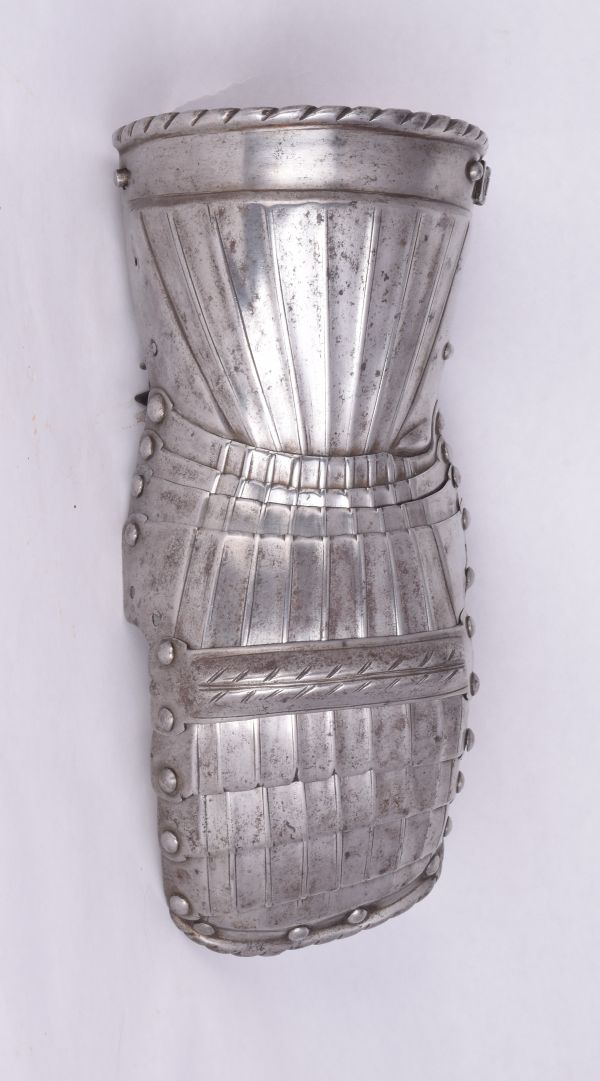
Gauntlet circa 1520-30
Metacarpal of four plates joined to fingers of four plates by a knuckle rider drawn up to a tall ridge with double lines of roping. Cuff of 2 plates opening on a hinge and closed by a pin. The cuff with an embossed teardrop shaped bump over the ulna. Cuff, metacarpal and finger plates fluted overall with parallel flutes accented with parallel engraved lines on each side of the flute. Buckle riveted inside the wrist of the cuff. A modern strap corresponds. Thumb missing. Rivets replaced (the thumb side rivet on the base metacarpal plate moved back). Internal cuff plate appears to be associated - probably from a slightly later (c. 1540) gauntlet and using a later 16th c. hinge.
Measurements: Weight: 15.6 ounces (440g).
Not for sale.

2 Gauntlets circa 1530-40
2 Gauntlets. Almost forming a pair. Both mid 16th century mitten gauntlets with 2 piece cuffs opening on a hinge and secured by a pin. The metacarpals formed of several small plates and one larger plate. The knuckle bows formed with a raised, roped ridge. Fingers covered by articulated plates, the terminal plates with roped and recessed borders. Thumbs protected by a large plate covering the base of the thumb secured to metacarpal by a hinge, with smaller plates secured to leather covering the remainder of the thumbs. Both terminal thumb plates with simulated finger nails. The Fitzwilliam collection in Cambridge contains a very similar pair of gauntlets (no. HEN.M.141-1933).
Weight: right 15.8 ounces (445g), left 1 pound 0.6 ounces (4750g).
Not for sale.
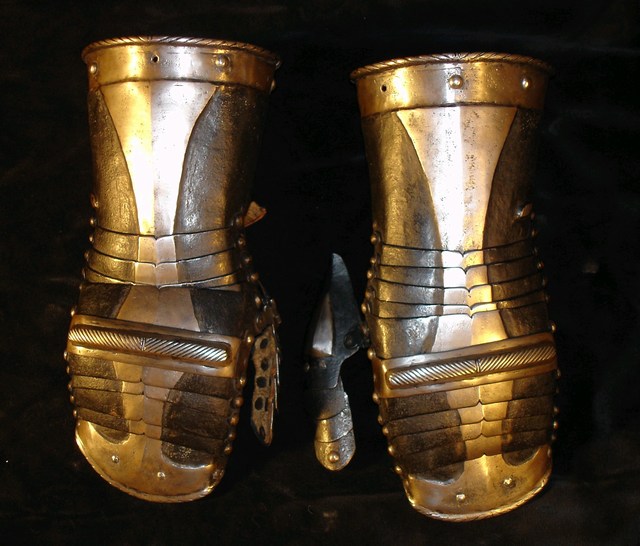
German black and white mitten gauntlets circa 1530-50
Short, almost straight cuffs formed of 2 plates rivited together. Cuff with rolled, roped and recessed border. Black surface rough from the hammer. White areas raised and ground smooth. Back of the hand formed of 5 plates. Knuckle plate fromed with a raised and roped ridge. Fingers covered by 5 articulated plates. Raised bands are normally associated with Augsburg. These gauntlets are relatively crudely formed, most likely for an arsenal armour. Small thumb lames replaced.
Weights: left 1 pound 2.6 ounces (525 g), right 1 pound 3.4 ounces (550 g).
Not for sale.

German fingered Gauntlet (possibly Brunswick) circa 1540-60
Long, pointed cuff formed with a gentle even flare over the entire length of the cuff. Central point. Border rolled and roped with an additional double row of raised decoration. Lining rivets around the edge of the cuff. Back of the hand covered by 5 articulated plates, the final plate larger than the rest. Knuckle plate decorated with a roped ridge with additional decorative grooves at the end and center. Thumb plate attached by a hinge. Fluted plate joining the knuckle plate to the fingers. One finger remaining. Interior cuff plate missing. Originally it would have been secured by a hinge on one side (half of the hinge remains) and a pin on the other side that would have engaged in the hole in the outer plate. A gauntlet of similar form with similar edge decoration is in the Keinbusch collection in Philadelphia.
Weight: 15.2 ounces (425g).
Not for sale.

Gauntlet for the left hand mid 16th c.
One piece cuff flaring from the wrist. Outer edge with an inward-turned, roped roll with a parallel recessed band. Central crease in the cuff. The main plate extends to cover half of the back of the hand and over the base of the thumb. The remainder of the back of the hand covered by 2 plates. The back of hand creased at the corners and at the center of the base of the thumb. Fingers covered by four plates, joined to the back of hand by a knuckle rider. The front of the knuckle rider and the fingers with fluted creases over the fingers. The end of the final finger plate with a hollow inward partial turn. The base line between the fingers accented by engraved lines. The ends of the plates are decorated with a filed notch on the end opposite the thumb. The thumb area is cracked. The form of the cracks and stiffness indicate it may have been tempered. Some original rivets remain, some replaced. The rivets on the terminal plate, articulation rivets between the last 3 plates, two of the metacarpal lame rivets, two rivets for securing the glove to the cuff and one of the rivets securing the inside of the wrist appear original. There are some small remains of fabric under some of the rivet heads. These appear to have been used to secure the glove.
Similarly constructed gauntlets are found in Mantova B34 (dated 1500-1505) and B35 (dated 1500-1510) - with an earlier form on the end of the cuffs, associated with Henry VIII's Tonlet armour (RA 11.7) dated to 1520 - but with an earlier form on the end of the cuff and Wallace A278 which is etched and has the final finger plate extended to form a locking gauntlet (dated 1570) and another plain but very similar gauntlet is illustrated on a suit dated to 1560 - #7 from L'Ameria Del Museo Civico Medievale De Bologna. An additional pair are displayed on the "Pembroke" armor in the RA (II.164). The form of this gauntlet is closest to the last RA example (II.164). The RA lists those as "associated.". The edge treatment on the cuff is later, but the form is similar - the later ones include a longer, more pointed cuff more typical of 1560-70.
Measurements: 10 1/4 in. long, 4 3/8 in. wide at the knuckle plate.
Thickness: Cuff generally .040-.050 in. The thickness rises at the wrist to .060 in. and very thin over the base of the thumb - .020 in. and in some places even thinner. Metacarpal, knuckle and finger plates .030-.040 in.
Weight: 15.4 ounces (435 g).
Not for sale.

Gauntlet mid 16th c.
Western European, possibly Flemish. One piece slightly flared cuff extending over the base of the hand. Single metacarpal plate. Roped knuckle plate and a single finger plate. The finger plate retains pairs of rivets in each finger, indicating that it was originally equiped with scaled finger plates for the individual fingers. The cuff with a crease aligned with the center of the back of the hand and two additional creases at the sides forming a "boxed" shape. There ia a single horizontal engraved line at the outside of the wrist which extends between the boxed creases. The border of the cuff formed with a file roped inward turn and a doubly recessed border. The border is interesting - the inward turn is narrow but the "roped" area is much wider. The exposed interior shows that the "roping" is actually partially embossed. Edges of the metacarpal and knuckle plate with scalloped edges. The overall form of the cuff and back of hand is similar to item number A-207. This one appears to be somewhat earlier. The ends of the knuckle plate are lost, so the original pivots have been replaced with rivets that stabilize the plates into position. A very similar pair of gauntlets are displayed with the "Pembroke" armor in the Royal Armouries (II.164), where the description indicates that they are "associated" with the armor.
Weight: 14.4 ounces (410g).
Thickness: varies significantly in the cuff plate - .037 in. up to over .070 in. The thickest areas are in the back behind the wrist. There seems to be little intentional thickness manipulation.
Ex. Col. Norman Fargo who built a major collection including early pieces from the Howard Curtis collection.
Not for sale.
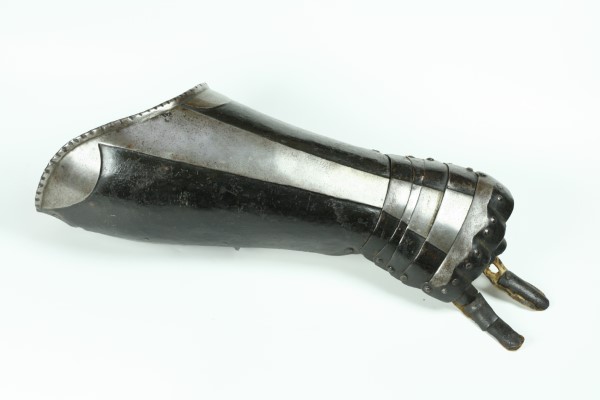
Two elbow gauntlets circa 1550-1575
Two gauntlets of similar form. Gauntlet cuffs decorated with arched raised 'white' bands instead of the more usual bands parallel to the edge. With older black paint.
Measurements:
Weights: right gauntlet 1 pound 6.4 ounces (635 g), left gauntlet 1 pound 8.8 ounces (695 g)
Not for sale.
Italian Gauntlets circa 1550-1580
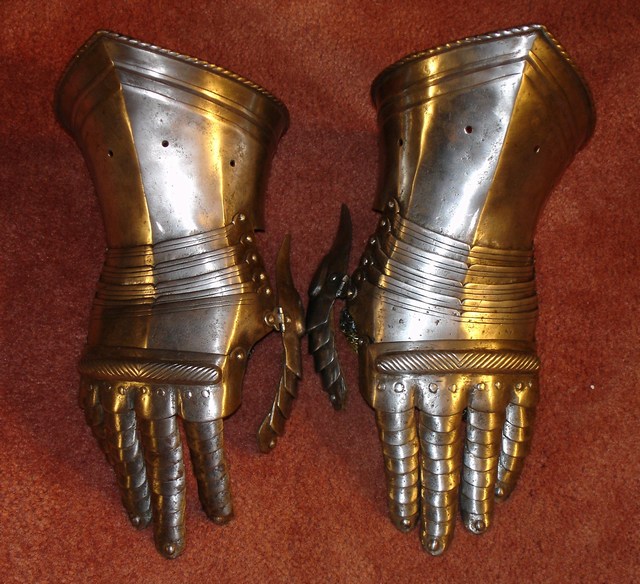
A pair of fingered gauntlets. Pointed cuffs of one piece with a central crease and joined at the inside of the wrist by 2 flush rivets. The seam stepped so that the outside is flush. The cuff is flared evenly thoughout its length. The outer edge of the cuff is bordered by a roped inward roll and a recessed border. The border includes a raised central ridge. The roll, central ridge and recessed border with single engraved lines. The back of hand is formed of 4 narrow plates toward the wrist and one wider plate at the knuckle. Each of the plates has a central crease with a notch in the edge aligned with the crease and a pair of incised lines parallel to the visible edge. The ends of the metacarpal plates have a shallow semi-circular extension with a small notch cut at the end of the extension. The extension allows the rivets to be mostly aligned with the edge of the plates. The knuckles are covered by a single plate with a central raised and roped ridge and the outer edge is shaped to the fingers. Thumbs of one large plate with a raised central tear-drop and scales covering the thumb. The main thumb plate is attached to the larger metacarpal plate by a hinge with one rivet on each end. The metacarpal plates are slightly boxed. Small finger and thumb plates replaced. Fingers re-leathered. Rivets replaced. Cleaned over-all. Cuff at the wrist roughly three and one half inches in diameter. Outer edge of the cuff tear-drop shaped 6 inches by 5 one half inches. Cuff 5 inches long at the point and 2 inches long at the inside of the wrist. Metacarpal app. 4 inches across at the knuckle plate.
Not for sale.

German pair of black and white elbow gauntlets circa 1550-1590
Good quality black and white gauntlets with raised bands and recessed ground. Bands polished. 2 marks on each gauntlet. On one, a recognizable part of the Nurenberg guild mark. Remaining marks unclear. Cuffs of 2 plates attached by rivets. Metacarpal of four narrow and one wider plate. Knuckle plate with raised, roped ridge. Additional plate formed to the fingers between the knuckle plate and finger plates. Large thumb plate attached to the large metacarpal plate with leather. Re-leathered fingers.
Weight: right 2 pounds 2.2 ounces (970g), left 2 pounds 0.6 ounces (920g).
Not for sale.
Gauntlet circa 1560-1600
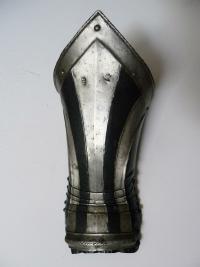
For the left hand. Flared and pointed cuff formed of two plates. The large outer plate rising to a point at the center and with three recessed bands and recessed border polished bright. Small ulnar bump. End of cuff with roped inward turned roll. Small inner plate with recessed outer border and narrow inward turned roll at the wrist. Back of hand formed of 5 plates, a roped knuckle rider and a plate shaped to the fingers to which the finger leathers were previously attached. Fingers and thumb missing. Two marks on the outer cuff plate - one a Nuremberg mark, the other indistinct.
Weight: 11.4 ounces (320g).
Not for sale.

Gauntlet circa 1560-1600
For the right hand. Flared and pointed cuff formed of two plates. The large outer plate rising to a point at the center and with three recessed bands and recessed border polished bright. Small ulnar bump. End of cuff with roped inward turned roll. Small inner plate with recessed outer border and narrow inward turned roll at the wrist. Back of hand formed of 5 plates, a roped knuckle rider and a plate shaped to the fingers to which the finger leathers were previously attached. Fingers and thumb missing. Two marks on the outer cuff plate - one incorporating MD over (possibly) a crown, the other indistinct. Losses to the cuff and metacarpal plates (metacarpal plates patched)
Weight: 15.2 ounces (435g).
Not for sale.

Finger plates circa 1560-1620
Three fingers from fingered gauntlets. Formed of overlapping plates (8, 10 and 11 plates respectively). Each of roughly rectangular form with a rounded and beveled front edge. Each attached to base leather with 2 rivets at the rear edge. All curved around the top of the finger. Terminal plate longer, with rounded end, secured by the third rivet at the tip and with embossed in the form of a finger-nail. Leather shows holes where it was stitched to the lining glove along the edge. 2 of the fingers secured to reinforcing cloth bands to stabilize the leather. Overall the plates taper toward the tip of the finger.
Not for sale.

Finger plates circa 1560-1620
Composed finger from fingered gauntlets
Not for sale.
Finger plates circa 1560-1620
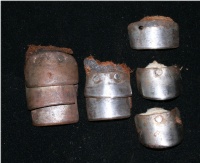
Separate finger plates from fingered gauntlets
Not for sale.

German Gauntlets 2nd half 16th century
Pair of gauntlets of steel painted black, each with pointed flared boxed cuff made in two-pieces with bright turned and roped borders along the outside followed by a double flute with central cusp on the inside, and each struck with a Nuremberg mark and indistinct maker's mark, 'H' in a shield, roped boss over the ulna, five metacarpal plates above three finger-plates below, each of the latter with bright embossed and roped knuckle-plate and all articulated on rivets, the lower plates each with border en suite with the cuff, one with keyhole piercing engaging with a locking-stud on the inner wrist-plate, separate hinged thumb-defences of four plates each, and each incised with roman numeral assembly marks on the inside from 'I' on the cuff to 'XII' on the terminal plate. 36 cm. and 38 cm. long.
Weight: right 1 pound 13.6 ounces (835g), left 1 pound 15.8 ounces (900g).
Not for sale.

Pair of finger gauntlets. late 16th-early 17th century
Probably Augsburg. Of blackened steel, each comprising a flared, boxed cuff with low medial ridge, and slender turned and roped border with a line of domed brass-headed rivets, roped boss over the ulna, seven overlapping metacarpal plates, a knuckle plate embossed over each knuckle, and an additional plate to which the fingers are secured all articulated with domed brass-headed rivets, overlapping finger plates riveted to leathers, separate hinged thumb guards and leather wrist straps with iron buckles. The final metacarpal plate is wider than the rest and is formed to the knuckle plate. Most of the rivets in the cuff, metacarpal and thumb are original. Remains of lining leathers. The wrist strap and buckle on the right appear to be original, the one on the left later (possibly working life) repair. Some finger lames original (most often these are all modern replacements). The cuffs are formed of an inner and outer plate, riveted together. The inner plate is boxed to go over the vambrace but fit close the wrist. There are assembly marks in the metacarpal plates. The plate to which the finger leathers are secured has pairs holes at the inner edge for attachment of the finger leathers (these are not currently used, instead they are attached by single rivets at the center of the plate).
Provenance: The collection of John Wilmot.
Weight: right 1 pound 0.4 ounces (465g), left 1 pound 3.6 ounces (560g).
Not for sale.
Mitten Gauntlet late 16th century
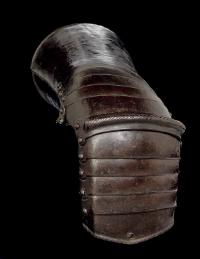
Of russet steel. Hand formed of 5 overlapping plates articulated to allow the wrist to bend down and up. Fingers covered by mitten plates formed of 5 separate plates, the final one with a narrow, inwardly turned, roped roll. Hand joined to the fingers by a roped knuckle plate. Cuff of slightly tapered tubular form made from an inner and outer plate. There is a small roll on the inside of the elbow. This was most likely intended to be used without a vambrace as a simple elbow gauntlet. The end of the cuff has a line of rivets to secure a leather strip, the terminal finger plate has a line of rivets to secure the glove and there are remains of a palm strap secured to the main hand plate. Half of the hinge for the thumb remains. The articulations on this gauntlet are very well executed. The rivets appear to be original. From the George F. Harding Collection, previously ex collection Henry Griffith Keasby. 14 5/8 in long.
Thickness - cuff .030-.042 back of hand .040-.050 fingers .025-.040 primarily around .032.
Measurements: Close inspection of the finger lames shows the center of the lames are 1.1-1.3 in. wide, the thumb side at the bend are just under an inch and the other side app. .93 in. Rivet tabs are app. .2 in.
Weight 1 pound 4.8 ounces (585 g).
Not for sale.

Half mitten gauntlet for the left hand late 16th century
German, probably Saxon. Cuff with long flared and pointed cuff formed of an outer and fixed inner plate. Back of hand covered by 5 narrow plates, one larger plate, a roped knuckle plate. The fingers half covered by three plates. Main borders with inward turned roped rolls and recessed borders. Retaining buff leather lining bands and strap for the palm. Cuff with small tear-drop shaped bump at the wrist. Cuff and terminal plate with recessed band that comes to a point at the center. Main hand plate with a raised area. All plates with central crease. Rolls and knuckle plate with fine roping. The small roll at the wrist on the inner plate is rolled out. Thumb replaced. Ex Coll. Ian Eaves then to Anthony De Reuck. With A d R collection tag.
Thickness: finger lames app. .032 in thick, Cuff .045-.060 in. thick (mostly in the .05 range), inner cuff plate mostly .040-.050 in. thick, main metacarpal plate generally .045-.050 in. thick.
Weight: 1 pound 5.2 ounces (600g).
Not for sale.

Two Elbow Gauntlets Late 16th c.
Similar, but not a pair. Elbow length cuffs formed of two plates joined down the sides with central crease that extends through the metacarpal plates. Metacarpals of seven (left) and six (right) plates, roped knuckle plate and fingers of four plates. The knuckle of the right narrower, the left broader. Thumbs protected by hinged main plate covering the base of the thumb extended with small plates over the fingers the terminal plate with chisel work simulating a thumb nail (missing on left). The main thumb plates with a central crease and rising to a point over the joint. Hinges with three knuckles and secured to the metacarpal and thumb by one rivet allowing the thumb to move in all directions. The rivet securing the hinge to the metacarpal shares the rivet that articulates the main and next plate. The elbow end of the cuffs and tips of the fingers with inward turned roped rolls. The wrist with a plain outward turned roll on the left and a roped inward turned roll on the right. Outside of the left with three chisel marks near the elbow end of the cuff at the center and with IIV on the interior. The interior of the first two metacarpal plates also stamped with VII. Pitted overall. A hole in each cuff that formerly secured them to shoulders for display. Similar in design to item number A-122, but not as precisely excecuted. For a very similar pair of elbow gauntlets see Churburg CH S164 and CH S165. They are described as Innsbruck 1580-1590 illustrated on page 343 of the Scalini catalogue.
Measurements:
Weight: Right 1 pound 6.2 ounces (635g), left 1n pound 7.8 ounces (680g)
Not for sale.

Gauntlet cuffs late 16th c.
Formed of two plates. The outer shaped to the elbow. Inward turned rolls at the upper edge. Wrist decorated with single incised line. Hands missing. Inventory number "2000.6.51" in red paint on the inside of the left.
Not for sale.

Gauntlet circa 1580
For the right hand. With flared cuff drawn out to a point in the center with one large fixed inner plate and a smaller additional plate on the inside of the wrist secured to the larger plate by two sliding rivets. There are two small holes at the center. These were likely to allow the small plate to be secured to the liner so that it would extend when the hand moved. The outer edge of the cuff with an inward-turned roped border. The outer wrist covered by two plates - the second larger and with an embossed ulna. Five plates over the back of hand and six plates over the fingers. The back of hand and fingers joined by a knuckle plate. The knuckle and finger plates embossed to simulate fingers. Decorated with incised lines. Iron rivets capped in brass. There is a strap and buckle at the wrist and an additional strap securing the fingers. There are signs of an additional palm strap. Old leather remains at the finger tips, end of the cuff and at the back of the wrist. This gauntlet appears to be original and untouched since its working life apart from a recent cleaning. There are some small, old modifications. One of the rivets securing the cuff to the first wrist lame has torn out and been replaced with one that also secures the buckle for the wrist strap. The rivets securing the final two finger plates and the leather strap are also more crude than the rest of the rivets. The thumb has been lost but half of the hinge remains. This gauntlet is very similar to A271 in the Wallace collection (identified as of Brunswick origin and c. 1560)
Weight: 1 pound 10.4 ounces (745 g).
Not for sale.
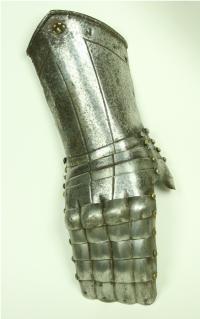
German Gauntlet circa 1580
Probably Brunswick. For the right hand. With flared cuff drawn out to a rounded point. Seven plates over the back of hand and four plates over the fingers. The knuckle and finger plates embossed to simulate fingers. Decorated with incised lines. Iron rivets capped in brass. The back of hand plates extend to cover the base of the thumb. The metacarpal plates include a set of false rivets simulating the end of the plates on a gauntlet built with a separate thumb defense. These line up with the rivet that secures the last hand plate. The metacarpal and finger plates are joined by a knuckle plate embossed to simulate knuckles. Part of the cuff plate is missing along with the inner plate. The cuff and back of hand plates are decorated by recessed lines. Many rivets with brass caps. One lining rivet with a rosette washer remains. From the Royal House of Hanover.
Weight: 1 pound (455 g).
Hand, finger and washers similar to gauntlets on item number 18 in the exhibition of Brunswick armor at the Tower of London in 1952. Decoration also matches other parts of the armor.
Not for sale.

Gauntlets circa 1580
One piece bell cuffs with 4 plate back of hand and a knuckle plate with a raised roped ridge. Hand plates with a single engraved line parallel to the edge. Cuffs with lightly roped inward turned rolls with parallel recessed border at the edge. Main thumb plate secured to the metacarpal by a leather strip. Scaled fingers and thump plates secured to leather. Restorations to the cuffs, fingers and thumbs by David Hewitt in 2021. Associated with the rest of the harness in 2021. Reasonably well matched, but liklely Italian and earlier.
Not for sale.

Gauntlet circa 1580-1610
Italian. Generally described as Pisan. Widely flared cuff drawn out to a blunt point with central crease and an inward turned roll . Back of hand consists of 5 plates the terminal one lightly formed to the knuckles. Etched in bands. Border etched to simulate a recessed border. Knuckle plate etched to simulate a raised roped ridge. Cuff and back of hand with a wide central band of etching with two additional bands on the cuff. Iron rivets with copper alloy caps.
Not for sale.

Pair of Gauntlets circa 1590
A pair. Cuffs long, flared and pointed with a central crease. Outer edge and wrist rolled inward and roped. The outer edge with an additional embossed and roped line. Raised over the ulna with a short roped line. Back of hand formed of 6 plates, the final one formed to the knuckles. Fingers and thumb of overlapping plates riveted to leathers by a single rivet in each plate. Assembly marks consisting of file notches starting with one on the lame next to the knuckle plate and increasing to five on the plate next to the cuff. These are placed on the inside front edge of the metacarpal plates. Thumb attached by a small hinge decorated with filed notches on each end. Images show the gauntlets in various positions with the metacarpal plates extended or bent back.
Weight: right 1 pound 6.2 ounces (625g), left 1 pound 6.6 ounces (635g).
Not for sale.

Elbow Gauntlets circa 1590
German. Nuremberg. Cuffs formed from two plates, back of hand covered by five plates, a knuckle rider and short mittens of two plates. The gauntlets are decorated with a central recessed band without a central crease. The border of the cuff is bordered by a recessed border and an inward turned rolled and roped border. The thumbs are protected by one main plate over the base of the thumb and three small scales over the thumb. They are currently secured to the metacarpal plates by a later leather. The gauntlets are nearly a pair. The right gauntlet has a rubbed mark in the recess of the cuff and signs of part of another one. The left gauntlet appears to have an associated inner cuff plate.
Not for sale.

Gauntlet circa 1590
Italian. Good quality Italian gauntlet for the left hand (fingers and thumb missing) etched in the characteristic Pisan fashion. One piece cuff joined with a rivetted overlap at the inside of flared form with inward turned, roped roll at the edge and a parallel raised, roped line with etching in between. Plain inward turn at the wrist. Back of hand covered by 5 plates and a knuckle plate with rounded areas over each knuckle. Hand plates with internal assembly marks in the form of 5 chisel marks at the edge. Retains some gilding. Ends of the metacarpal plates at the thumb side with multiple decorative notches, single notches on the opposite side. Associated with a lower quality modern copy of a right gauntlet with similar etching. Modern copy not forming a pair.
Not for sale.

Gauntlet thumb 16th century
Thumb from a duelling gauntlet. The plates are attached to leather allowing them to move easily over one another. Original leather remains. The plates overlap in the opposite direction from normal gauntlets allowing it to be used for parrying.
Not for sale.
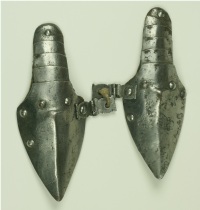
Gauntlet thumbs 16th c.
Two thumbs for the right hand adapted to form a pair by moving one hinge to the other side. Complete with the base plate, hinges for securing them to the gauntlet, and four finger plates. The terminal plate with a recessed terminal simulating the finger nail. All of the plates secured by original leather which extends to cover most of the main plate.
Weight: 4.0 ounces (115g).
Not for sale.

Gauntlet circa 1600
Gauntlet. Full bell cuff. Metacarpal formed of articulated lames. Knuckle plate in the form of knuckles. Fingers and most of the thumb lacking. Base plate of the thumb protection remains. Shows atypical thumb protection used on some italian gauntlets where the entire thumb depends from a plate rivetted to the cuff instead of from a hinge attached to a metacarpal plate.
Weight: 10.8 ounces (300g).
Not for sale.

Elbow Gauntlets circa 1600-20
Long, tapered cuffs extending to provide additional coverage at the elbow. The cuffs formed of an outer and separate inner plate. The back of hand covered by five metacarpal plates secured to the cuff by a wrist lame. Knuckle plates formed with a transverse rib and shaped to the fingers. Finger plates secured to leathers. Base of thumb covered by large plates secured to the last metacarpal plate by a leather hinge, extended over the thumb with scales. Some terminal finger lames decorated with a stylized finger nail. The cuffs bordered by brass capped lining rivets retaining portions of what appears to an original strap that secured the gloves (showing signs of the original stitch lines). Back of hands and fingers not as nice as the cuffs. They may have been added.
Not for sale.

Gauntlets circa 1610
Etched in the 'Pisan' fashion. One piece cuffs with overlapped join at the wrist. Metacarpal formed of 4 plates. Knuckle plate formed to simulate knuckles and etched to simulate a roped ridge. Interior of the metacarpal plates marked with single notch assembly marks on the front edge. Rivets replaced. Small patch to the thumb side of the second plate from the knuckle. Single rivet filling a hole in the edge of the cuff next to the metacarpal which would have originally secured the thumb defense.
Not for sale.
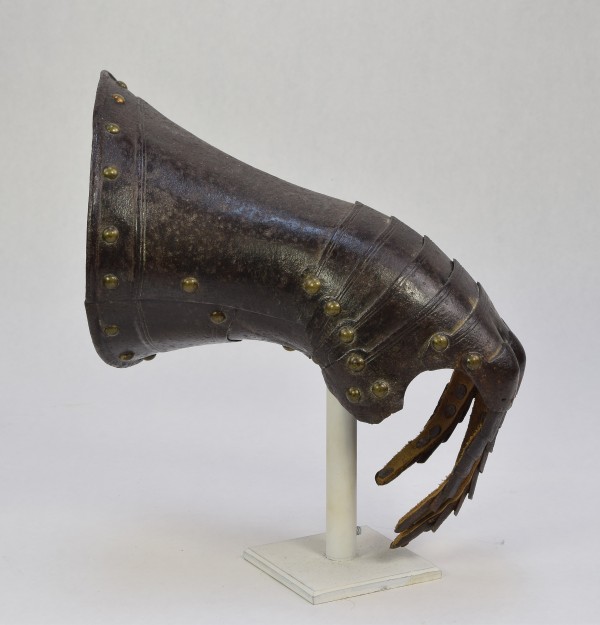
Gauntlet circa 1620-30
English, Almost certainly Greenwich. Cuff of flared form with a small point at the center and with a central crease. The cuff is formed of a large, shaped outer plate and a small inner plate. The inner plate is fitted with a wrist plate that extends over the base of the thumb. The end of the cuff borndered by a plain inward roll, a recessed border and two parallel engraved lines. The forward edge of the inner thumb plate with a plain inward turn and a pair of engraved lines. The back of the hand and base of the thumb covered by five metecarpal plates and a plate shaped over the knuckles. The fingers and thumb covered by pointed scales with a longer scale covering the finger tip. The edges of all of large plates bordered by pairs of engraved lines. The finger plates bordered by single engraved lines. Lining and articulation rivets capped with brass. Remains of lining leathers at the outer edge of the cuff, along the edge of the wrist/thumb plate and under the articulation rivets opposite the thumb. The back of the hand is elegantly shaped. The points at the center of the metacarpal plates and the centers of the knuckles identify this as a 17th century piece. The central crease in the cuff and metacarpal plates is curved to allow it to follow the center of the natural bend of the hand away from the thumb. The two close up images of the back of the hand show the plates (almost) fully collapsed and fully extended. Similar gauntlets can be found on surving 17th c. Greenwich harnesses. The best match I have found is on RA II.94. Another of these 17th c. Greenwich harnesses is II.73.
Measurements:
Weight: 1 pound 6.8 ounces (650g).
Exhibited: Feb. 10 2023-Feb. 29 2024 Orange County Historical Museum Hillsborough NC
Not for sale.

Gauntlet circa 1620-30
Consisting of a flared one piece cuff joined at the inside and shaped to the base of the thumb. Back of hand covered by seven cusped metacarpal plates and one lobed knuckle plate. The knuckle plate has one rivet in the center of each lobe to secure the leather that would have carried the finger plates. The edge of the cuff at the base of the thumb is slightly flared and has a short crease. This form would have extended over the separate plates that covered the base of the thumb. The main edges of the cuff with file roped inward turned rolls. The one on the outer edge with a recessed border. The roping is formed of very fine, filed, narrowly-spaced lines. The edges and center of the metacarpal and knuckle plate with pairs of incised lines. Final two images show a comparison between two gauntlets from the same time - this one and item number A-227 made in Greenwich.
Weight: 1 pound 1.4 ounces (500g).
Not for sale.

Gauntlet (part) early 17th century
Consisting of five metacarpal plates and a knuckle plate. The rear edges of the plates bevelled and filed with a fine cusps. Each knuckle with two rivets to secure the finger plates. Each with tripple engraved lines.
Provenance: Formerly in the collection of Leonard Heinrich - armourer to the Metropolitan Museum of Art, NY.
Weight: 2.8 ounces (85g).
Not for sale.

Gauntlet (part) 17th c.
Cuff and 5 plates covering the wrist and metacarpal. Triple incised lines at the edges of the plates. Central plate underlapping both a small cuff plate and 4 metacarpal plates. Central plate with horizontal raised ridge. Atypically for this date, the rivets include slots on the interior plates allowing for sideways movement. Cuff of a single plate with a riveted overlapped seam at the inside of the wrist. Some rivets lost. The cuff is narrow and almost tubular. The edge of the cuff with a very narrow plain roll. There is a row of small, closely spaced holes inside the roll at the edge of the cuff. It would appear that these would have been used to stitch the glove or lining strip to the cuff in place of the more usual riveted leather band.
Not for sale.

Gauntlet 19th c. in 16th c. style
Flared cuff. Metacarpal of multiple plates. Odd knuckle bridge and half mitten finger plates.
Not for sale.