
Burgonet circa 1510
Shallow skull with a low roped ridge forming a simple crest. The bowl extends slightly to cover the forhead and farther to cover the neck. Deep fall with wide rounded brim. The outer edge of the brim with a shallow inward turn. The helmet only really covers the head because the fall extends 1 1/2 in below the front edge of the bowl. This allows a shallow bowl to cover the head reasonably. The neck is covered by a single rounded tail lame with a simple raised border on the outside edge. One hinge for the lost cheek pieces remains. Painted overall with a black finish over what appears to be a smooth surface. There is a hole in the top of the skull at the back of the crest the back of crest and the skull around it have been flattened. In its orignal form the top would have been rounded like the front. The brim of the fall is bent at the center. There is also what appears to be a mark in the center of the brim. This appears to be a D on its back. This has been found on pieces made in Nuremberg for Vienna like no. 256 from Das Wiener Burgerliche Zeughaus - 1977. This is a simple example of a very early 16th century style of burgonet. The hole and lost checkplates are later damage, but the form shows the lack of symmetry that is common to many pieces of armour. Similar to item number A-270.
This style of helmet does not survive in large numbers. It would have been a pretty low end helmet used on simple infantry armors in the early 16th century. These armors wer manufactured in large numbers, but relatively few survive. Two similar helmets are illustrated in "Das Alte Zeughaus Solothurn" by Nicolo Vital (text) and Benedicht Weibel (photos), Verlag Vogt-Schild AG, Solothurn, 1980 on page 139 where they are displayed with early 16th c. breastplates.
Measurements: front to back of the bowl 7 5/8 in., side to side 6 7/8 in. Fall 2 1/4 in. tall (tapering to 2 on the left side) and brim 1 5/8 in overall (tapering to 1 3/8 on the left) tail lame 1 5/8 on the left and 1 3/8 in. on the right where it sits off the skull - the overall length from the skull is 1 5/8 on both sides.
Thickness: brim mostly .042-.048 in. Skull mostly app. 050 in. but there are some spots thinning to .030 and up to .070 in. Tail .058-.062 in.
Not for sale.
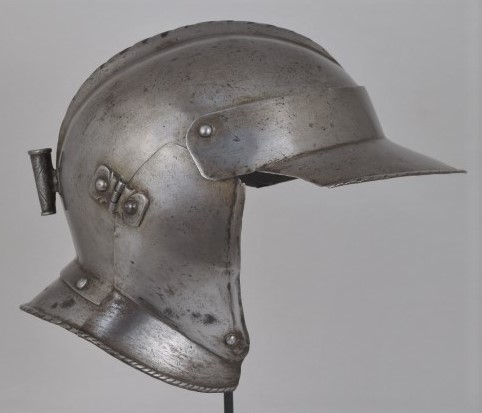
Burgonet circa 1510
Small, low combed with a movable fall and cheek plates. The bowl formed in one piece with a low central, roped comb. The fall is secured to the bowl by two rivets that allow it to be raised. The upper part of the fall is taller than many, extending the skull slightly. The fall overlaps the cheek plates, locking them in place when it is down. The tail is a separate piece riveted to the inside of a flare on the back of the skull. It is more typical for this to underlap the skull. The outer edge is rolled inward and roped. Cheek pieces are secured to the skull by external hinges. This is not typical of later pieces where hinges are generally inset. The cheek plates have rolled and roped borders at the lower edge. The lower edge of the cheek plate extends the flare of the neck plate. The flare is formed as a separate piece riveted solidly to the cheek plate. The face hole of the cheek plates is formed with a simple hollow bump. There is a decorated iron plume holder at the back of the skull. This is an example of a very early form of burgonet. It would have been used with a simple Maximilian armour, possibly with a splint armour. That is how it is displayed in this collection. Similar to item number A-182.
This style of helmet does not survive in large numbers. It would have been a pretty low end helmet used on simple infantry armors in the early 16th century. These armors wer manufactured in large numbers, but relatively few survive. Two similar helmets are illustrated in "Das Alte Zeughaus Solothurn" by Nicolo Vital (text) and Benedicht Weibel (photos), Verlag Vogt-Schild AG, Solothurn, 1980 on page 139 where they are displayed with early 16th c. breastplates. The sketch shows the relationship between this helmet and a simple skull cap - item number A-123.
Measurements: Weight 1 pound 14.2 ounces (860g). Thickness of the bowl varies between .02 and .06 in. but is mostly around .035 in. The variation is pretty random, the thickest part being in the back left. Brim .023-.032 in. Cheekplates .016-.034 mostly app. .025 in.
Not for sale.
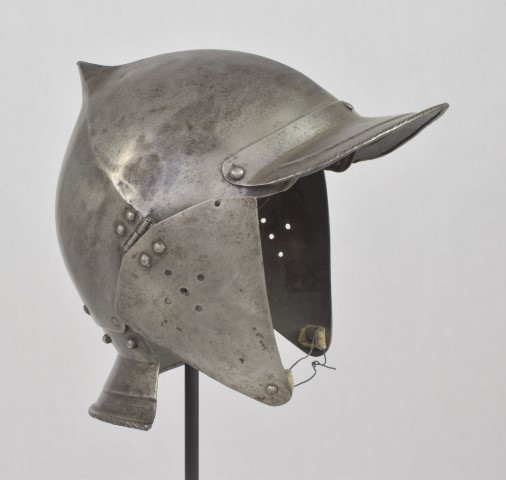
South German Burgonet circa 1540
One piece skull formed with four triangular panels rising to a near pyramidal point, fitted with fixed peak and neck guard each with recessed border and finely roped edge. With a pair of simple cheek plates. A burgonet of similar form and struck with the mark of the Vienna City arsenal is preserved in the Fitzwilliam Museum Campridge (inv. number HEN.M.80-1933). Thickness of the bowl generally .035-.040 with some spots as thin as .022 and some thick spots over .050. Weight 2 pounds 5.6 ounces (1075g)
Not for sale.

Burgonet circa 1540
Atypical early form - the bowl of rounded form with four creases and coming to a small bent point at the top center. The bowl covering the top, front and back of the head and flared at the back for a single neck lame. Sides of the face covered by cheek plates (the right a good replacement) and the front with a pivoted fall which comes to a point at the center. Edges of the fall, cheek plates and tail lame with inward turned, roped borders. The similar helmets illustrated in volume II of the KHM catalogue date the pieces with similar skulls to 1535. This piece is very closely related in shape and quality of construction to parts that survive from a large number of half armours that were bought by Vienna from Nuremberg in the 1540's. Marked on the outside of the fall with a Nuremberg shield mark (partially stamped) and on the inside of the fall with what appears to be an N in a circle (again, partial).
From what can be seen, it appears that the helmets illustrated in Das Wiener Burgerliche Zeughaus - 1977 on plates 32 and 33 are similar. There are many similarities to the helmet on Wallace A40 (it has a higher point, and black and white decoration, but the bowl shape, fall, face line, form of the cheeks and even the pair of additional holes over the cheek plates are similar).
Height: 9 1/2" tall. Weight 2 pounds 10 ounces (1200g).
Thickness: Skull mostly .05-.06, but with thin spots at .03 and thick spots up to .07. Brim mostly .04-.05 thinning at the right side toward the back down to .025 and some thicker spots up to .065. Cheek plate mostly .035-.055.
Not for sale.

Burgonet mid 16th century
One piece skull with four creases rising to a tall point at the center. Bluntly pointed peak formed as part of the bowl. The skull retains its original blackened finish and padded lining. Originally formed with white bands at the creases and on the brim, later (during its working life) to overall rough from the hammer and blackened. Likely at this same time the tail lame was replaced by the current tail. Cheek plates modern replacements. Lining attached to leather strips secured by a line of rivets above the brim and tail. Quilted lining of 2 layers stuffed with fibre. Each layer formed in 2 halves with a central seam front to back.
Not for sale.
Burgonet circa 1550
rounded bowl with frour creases - at the front, back and sides rising to a blunted point and extended in the front to form an integral up turned brim. Separate tail lame. Two cheek plates (left one certainly replaced, right shows more interior age, but also possibly replaced). Decorated with raised polished tapered bands along the creases and along the borders of the brim, neck lame and cheek plates. The recessed areas rough from the hammer and blackened with paint. Outer edge of the brim, neck lame and lower edge of the cheek plates with roped inward turned rolls. Hinges, rivets and plume holder replaced. Some holes patched with modern internal patches.
Not for sale.

Burgonet circa 1550-70
One piece skull boxed in four panels and rising to a point with an acorn finial. Integral brim, separate neck lame, two cheek plates (left associated,re-worked to fit, probably from the same original arsenal and from a similarly decorated, but slightly different helmet). Main edges with roped inward turns and recessed borders. The helmet decorated with four raised polished 'white' bands that continue onto the neck guard and peak. The edge of the peak, neck lame and cheek plates decorated with inward turned roped rolls. Formerly black and white. Cleaned. Black areas reblackened with paint to simulate original appearance.
Not for sale.

Burgonet circa 1560-1600
German, probably north German. Two piece skull joined down the center at the comb - the wearer's right side rolled over the left. Separate brim and tail plates. Cheekplates at each side hinged at the upper back. Skull with elegant tall, narrow comb joined with a roll. Where the comb ends at the front and back there is a short flush riveted overlap. Arched crease on each side of the skull. Borders with a plain round inward turned roll with a parallel recessed border. The recess coming to a cusped point at the center of the brim and the center of the neck. Each cheekplate with borders en-suite. The center of each decorated with a raised embossed flower. The brim is secured inside the skull. The tail lame follows the normal pattern and is riveted on the outside of a flare at the base of the skull. The hinges that secure the cheek plates are riveted inside the skull with 3 rivets on each side of the hinge. Retains original brass capped rivets throughout (some have damaged or lost caps). Most internal washers for the leathers seem to be original as well. They appear to be a mix of flat cut washers and "donut" washers. The left rear has a brass plume holder attached within the line of lining rivets. Various signs of delamination, primarily on the interior. The surface is pitted and cleaned. Close inspection of the finish indicates that the main surfaces were originally rough from the hammer and blackened. Double incised lines can still be seen along the secondary edges of the tail lame and cheek plates. With a black surface and polished borders and flower, this would have been a very elegant piece. Unlike low end, munition burgonets the cheekplates would have originally been lined just like the skull - the rivets and washers remain that would have secured the leather strip.
This is a very interesting piece. It is large in size and relatively high end. It appears to be mid-late 16th c. but is constructed from 2 halves with a separate brim. This is more common in the 17th c., but there are some high end examples of pieces used in France and burgonets that are styled more like morions that are also made this way in the second half of the 16th c. This appears to be another example of that less common style of construction in the 16th c. The use of 3 rivets on each side of the hinges, crease in the skull and the embossed flower really bring this up to it's own level. Most inward turned rolls in the second half of the 16th c. are roped. The rolls on this piece are not - they are left plain. This happens, but it is much less common. Looking at the interior we see interesting hammer marks. These illustrate how the decorative elements were formed. The most obvious area is in the decorative flowers in the cheek plates. We see very clear narrow tool marks that tell us that they were embossed from the inside using a narrow faced hammer. We see the same marks at the creases in the bowl and decorative elements in the border work. Another interesting note, even at this level the "rolls" at the face edge of the cheekplates are not rolls, they are hollow.
Measurements: Weight: 4 pounds 6.4 ounces (2 kilo). Thickness (measured in inches) - skull varies .045-.078, mostly .055-.062. Brim .060-.080. Left cheek plate .045-.052.
Not for sale.

Burgonet circa 1570
One piece skull with medium height roped comb. The surface rough from the hammer. Comb, a narrow band on the skull, neck line and recessed borders and rolls polished bright. Separate neck lame and pivoted brim. Cheek plates, brim, and neck lame with recessed border and inward turned roped roll. Skull marked with Nuremberg touch mark. Cleaned. Delaminations in various places, esp. in the upper part of the brim. The skull just above and behind the location of the right hinge has a working life internal patch and some additional stabiizing rivets. This area seems to have often caused problems with delamination. One cheek plate associated and partially re-worked.
Measurements: Weight 3 pounds 4.8 ounces (1500g). Thickness of the skull varies .025-.06 in. generally .035 -.045 in. Thicker at the back and near the hinges.
Not for sale.

German Burgonet late 16th century
Skull with low comb which sweeps up from the bowl, integral brim, single tail lame and cheek plates on each side. Cheek plates secured to the bowl by hinges, the bottom edge flared to extend the line of the tail. Border of the brim, tail lame and bottom edge of the cheek plates with small, round, internally turned roll. The shape of the bowl and comb points to a late 16th c. origin and manufacture in Augsburg. This shape is similar to the distinctive skulls found on Augsburg armors, particularly famous from the works of Anton Peffenhauser. Most of the burgonets which survive have a hard change of line between the skull and comb. Retains old lining. Overall finish rough from the hammer - the helmet was shaped and plannished with a hammer to its final shape, but it was never ground to eliminate the hammer marks. There are signs that it was then left 'black' - the oxidation from heating the helmet during its construction was not removed - and then probably painted. It was cleaned such that much of the oxidation and any original paint have been removed. Reblackened to restore the original look with paint. The lining is attached to two strips of leather which are riveted to the bowl of the helmet above the face and at the neck (these lines of rivets can be seen in the picture). This would originally have been the type of helmet that was kept in an arsenal and issued to soldiers. Unlike the highest quality custom burgonets, the cheek plates were not originally lined. One of the cheek plates is associated. This plate was originally polished. Linings remaining in armour are very rare.
Not for sale.

German Burgonet late 16th century
This is a good example of the type of helmet that would have been warn by the light cavalry units in all of the armies of western Europe during the second half of the 16th century. Originally (as now) with a polished surface. One piece skull. Nuremberg stamp. Good form overall. Lining rivets securing leather strips to skull. Rivets and leathers replaced. Helmet overall cleaned.
Not for sale.
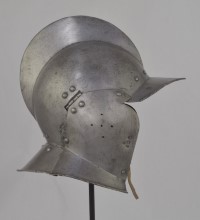
German Burgonet late 16th century
One piece polished skull. High roped comb and integral brim. Separate neck lame and hinged cheek plates. Lower edge of the neck lame and cheek plates with inward-turned roped roll. Front edge of the cheek plates with simple turned in border. Cheek plates pierced with 5 holes over the ears in dice formation. Edges of the cheek plates and neck lame beveled. Nuremberg guild mark on the brim near the center. Right cheek plate stamped with Solothurn arsenal inventory numbers x 126. This helmet retains its original plume holder. Hinges appear to be original. Most remaining rivets appear to be original. The rivets that secure the leather loops at the chin of the cheek plates are replaced (as is the leather). The finish shows signs of areas that have rusted and cleaned, but many parts of the surface show signs of the type of scratches that are typical of old munition polished surfaces. These can be seen in large numbers in the close up images of the brim and the flare on the cheekplate. Similar, even more aggressive marks can be seen on the munions item number A-292.
Provenance: Bischoff Collection, Vienna.
Exhibited: Feb. 10 2023-Feb. 29 2024 Orange County Historical Museum Hillsborough NC
Not for sale.
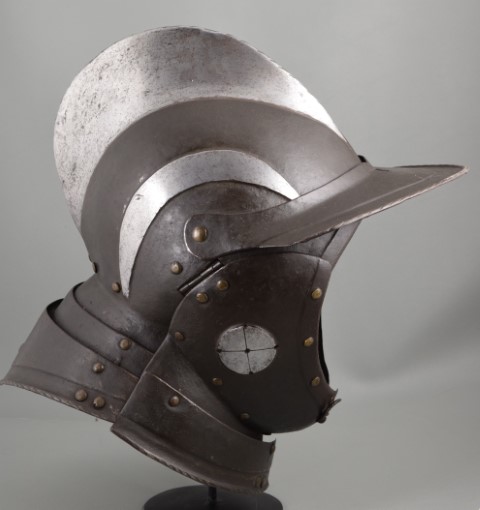
Burgonet Late 16th c.
South German. Black and white. One piece skull with high comb. The comb, a band along the face and an arched band on each side polished, the remainder black and rough from the hammer. Cheek plates hinged at the sides of the skull in the normal fashion, but extended to join under the chin where they overlap and are secured by a pin and hook. Each cheek plate with a raised polished area over the ear pierced with 5 holes connected by engraved lines. The front edge of the cheek plates continues the raised, polished band from the skull. Moveable peak pivoted at the sides of the skull. The bottom of the skull and cheek plates continued by separate plates - two over the neck and one on each cheek plate. These are secured to the skull by internal leathers and to the cheek plates by a sliding rivet at the back and leathers at the front. Edges of the peak and neck plates with a recessed border and inward, roped turns. Lining rivets at the base of skull along the neck continuing across the cheek plates and at the face hole. Most rivets of brass mimicing some (probably) original iron capped rivets. Nice, higher end example.
Not for sale.

Burgonet circa 1580
Once piece skull rising to a high comb and extended at the front and back to form a brim and tail. Small cheek plates at each side. Etched in the Pisan manner. When purchased coated in old, browned varnish with some rust underneath. After cleaining, the surface is in reasonable shape with most of the etching remaining with good detail. There is some brazed repair to the top of the crest and a larger soldered repair to a small portion of one side of the crest. The point of the brim is slighly bent. Cheek plates not quite a pair. Nice full form with high comb and small cheekplates typical of the style. Currently displayed on the half suit item number A-249.
Not for sale.
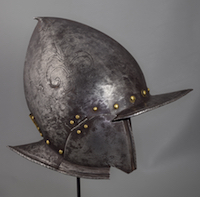
Burgonet circa 1580
Tall form with nice stalk. Integral brim and tail. Surface rough from the hammer. Edge of brim and tail with nice inward turned roped rolls bordered by a narrow recess. Sides engraved with stylized Fleur de Lys. Point and brim with additional fleur decoration. Sides with small cheek plates wth rolled and recessed borders (restored). Skull with line of copper alloy capped iron rivets at the brim and tail for securing a lining strap. Small copper alloy plume holder at the back. A nice example of an interesting form of burgonet. Similar to item number A-380. The Poldi Pezzoli museum has several of these (numbers 71-92 in the catalogue Armi e armature Museo Poldi Pezzoli of which two are illustrated on page 35).
Not for sale.

Burgonet circa 1580
Pointed skull rising to a nice stalk. Creased front and back. Skull extending to a pointed brim and neck. Cheek plates at each side. The edges of the brim, tail and cheek plates with inward turned roped rolls. The brim, tail and front edge of the cheek plates with parallel narrow recess. Lining rivets at the brow and neck. Some rivets (both lining and rivets for the hinges) retaining decorative washers or parts of washers. The cheek plates secured to the skull with interior hinges. Each cheek plate pierced with 5 holes over the ears in a dice pattern. Left hinge likely replaced. Tip of the tail lost. Some deformation to the base flares on the cheek plates and brim. Some delamination in the edges, bowl (esp. near the point) and left cheek plate. Finish might reflect the original in many areas. It appears to show signs of a rough file/grind not quite completely smoothing out the hammer work. Interior of the base of the skull and right cheek plate marked with two chisel marks. Any sign of chisel marks on the left cheek plate obliterated by cracking. Similar to item number A-305. This style of burgonet is very similar to some of the more elegant cabassets (for example item number A-323), but with cheek plates instead of the side brim. Very lightly cleaned to remove old yellowing varnish and small areas of active rust. The surface - wavy surface, spots of oxide and scrathes - remains as it was when aquired.
Not for sale.
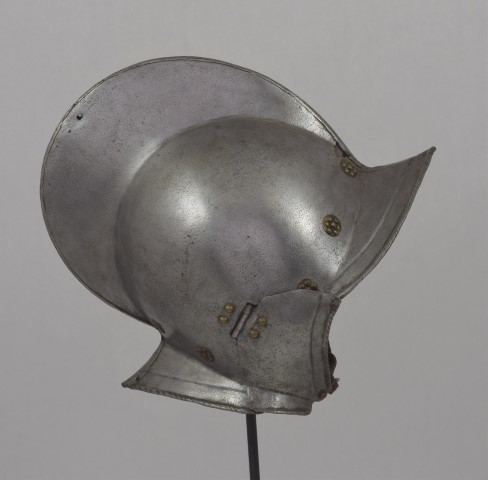
Burgonet circa 1580-90
Burgonet. 2 piece skull with origninally smooth surface. Extremely high, rear-swept comb. Pointed brim and tail integral to the bowl, each with rolled, roped and recessed borders. Small, original cheek plates with rolled, roped and recessed borders. The form of the bowl is remeniscent of morions at the time with aggressively pointed brow and neck. Shows signs of significant pitting and later cleaning. Rivets and decorative washers replaced. There seem to be some signs of likely original deep scratches from the cleanup of the piece at the back next to the crease and at the base of the comb.
Weight: 3 pounds 5.2 ounces (1510g). Thickness generally .030-040, some areas a little thicker.
Not for sale.

Burgonet circa 1580-90
Skull formed of two pieces joined down the center. High comb and pointed brim and nape. Edges of the brim, neck and cheekplates with small inward turned rolls at the edge which are heavily roped with broad dents. Inside the rolls there is a wide recessed border which contains a central raised ridge. The comb is lightly roped with diagonal filed lines. Dome headed lining rivets in the skull at the base of the brim and nape securing remains of lining leathers. The bowl is formed the way two piece morions are formed - the brim and tail are integral to the bowl and the seam runs out to the points at the crease. The inside of the brim and one cheek plate are marked with three parallel chisel marks. These seem to have been used to keep parts organized during construction.
Measurements: weight: 3 pounds 11.6 ounces (1685g). thickness: skull generally .045 in. varying .025 to .055. Brim slightly thicker generally .053-055 in. left cheek .035, right cheek .025.
Not for sale.

Burgonet circa 1590
German. Nuremberg. Burgonet with one piece skull rising to a high comb at the center and extended to form a brim at the front. With two cheek plates and a separate tail lame. The cheek plates are extended to match the length of the tail lame with separate fixed plates. The edge of the brim, cheek plates, tail and a raised circular area in the middle of the cheek plates are polished bright against a blackened background. The edge of the brim and lower edge of the tail and cheek plates are bordered by inward-turned, rolled borders. The edge of the brim shows a delamination and crack which exposes wire in the roll. The cheek plates are pierced with 5 holes over the ears. The burgonet has a tubular plume holder decorated with diagonal lines secured to center of the back. There are remnants of lining leather at the brow and tail. Some of the leather survives at its full width. Where this is the case, there is a line of small holes showing signs of stitching. The interior of the tail lame includes some signs of old painted arsenal or inventory markings in red and yellow. These appear to be 18 or 81, U8 and ZS. The inside of the skull shows signs of earlier white bands that were most likely raised. These have been removed during the working life of the helmet. Small remains of the band can be seen on the left forhead above the brim, and there are two lines of tool marks defining the former bands on the inside. Since there are only two lines, the band was almost certainly raised. Recessed bands tend to have a central crease, which would have left a third line of tool marks. One cheek plate (the right) may be an old association. The right hinge is replaced. Obtained and displayed as part of item number A-218.
Measurements: Weight: 4 pounds 0.6 ounces (1830g). Height 12 1/4" tall.
Thickness: Skull generally .060-.075. A band of material about an inch from the crest is .085-.090. It thins app. where the old white band was hammered in. Then stays thinner at the sides. Brim .070-.025, generally tapering toward the front. Left cheek plate .038-.045. Right cheek plate similarly variable, slightly thinner - .035-.042. Tail lame .035-.045.
Not for sale.

Burgonet circa 1600
Burgonet. Smooth surface. Nuremberg form. One piece bowl. High, straight comb. Brim formed of a separate piece. Original cheek plates with simple hole decoration. Original (probably from the manufacturing process) patch inside the edge of the skull under the right cheekplate. De-laminations in the bowl and brim. Tail plate missing.
Not for sale.
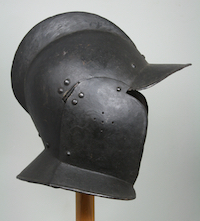
Burgonet circa 1600
South German, probably Augsburg. One piece skull with high comb and integral peak and (atypically) neck flare and a pair of cheek plates. Inward turns at the edge of the peak, neck and lower edge of the cheek plates. The face edge of the cheek plates with a simple raised edge. Each cheek pierced with 5 holes at the center. Retains lining rivets at the face and neck. Rough from the hammer. One large hole in the back of the crest and an H pattern of smaller holes above the neck in the skull. The larger hole likely from how the piece was mounted in a display. Purpose of the smaller holes unknown. Retains blackened finish refreshed with paint. The integral neck flare is very unusual. It is present on some higher end burgonets often ascribed to an Augsburg origin, but generally the shape is more sweeping and less similar to the form of the burgonets with a neck lame.
Not for sale.

Burgonet circa 1600
Augsburg. One piece skull with high angled comb and integral peak. Single neck lame and a pair of cheek plates. Rough from the hammer. Point of the peak with two marks, one the Augsburg pinecone, the other indistinct. The edge of the peak formed with a simple inward turned roll coming to a blunt point at the center and with a central crease. Neck plate with plain inward turn at the outer edge coming to a blunt point and with a pair of holes near the point for suspension in an arsenal. Cheek plates with a simple bump at the face, inward turned roll at the bottom and pierced with five holes over the ear. Retains lining rivets at the neck and forhead. Signs of delamination esp. in the rolls on the peak and neck lame and at the edge above the cheek plates which also shows signs of folds and cracking which has been repaired during manufacture.
Weight: 3 pounds 7.8 ounces (1585g).
Measurements. As one would expect, the thickness varies significantly. The bowl is mostly something around .055 in. (The front of the skull thicker, areas up to .078 and one area above the right cheek plate .090., thins toward the base of the brim to .035-.045, brim .029-.070 generally thinner in the middle, the lower back of the skull .020-.037, seemingly intentionally thinner), The tail plate .035-.055, the cheek plates mostly about .035 in. (varying between .028 and .044) The cheek plate does not get thinner as you approach the bottom of the flare, so the bottom of the cheek plate is not formed by a simple flare.
Not for sale.

Burgonet circa 1600
South German. Two piece skull with high comb and integral peak and neck. A pair of small cheek plates. The two halves of the skull joined by a roll at the top of the comb and simple overlaps in the peak and neck. Rough from the hammer. Lining rivets at the face and neck lines. The lining rivets with embossed decorated brass washers. This is comparable in construction and style to A-105, but that was originally a much nicer piece. This is the munition version of that. A similar burgonet is illustrated in plate 52 in Musee De L'Armee Paris - Les Armes Et La Vie - Dargaud Editeur 1982. It is described as c. 1550, but that seems early.
Not for sale.
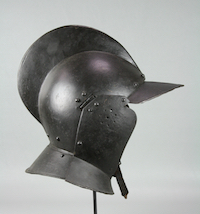
Burgonet circa 1600
South German Probably Augsburg. Two piece skull with high comb and separate inset peak and separate neck lame. A pair of cheek plates (the left probably associated and slightly worked to fit at the bottom). The hinge badly replaced on the re-worked cheek plate. The two piece construction is much nicer than many helmets. The two halves fit, are at the same level and the seam in the comb can be confused with an engraved line (which it was in the auction description where it was described as having a one piece bowl). Rough from the hammer. Edges with plain inward turns. Lining rivets at the face and neck lines.
Not for sale.

Burgonet circa 1600
Augsburg. One piece skull with high angled comb and integral peak. Single neck lame and a pair of cheek plates. Rough from the hammer. Point of the peak with two marks, one the Augsburg pinecone, the other indistinct. The edge of the peak formed with a simple inward turned roll coming to a blunt point at the center and with a central crease. Neck plate with plain inward turn at the outer edge coming to a blunt point and with a pair of holes near the point for suspension in an arsenal. Cheek plates with a simple bump at the face, inward turned roll at the bottom and pierced with five holes over the ear. Retains lining rivets at the neck and forhead which still secure remains of the leathers. Signs of delamination esp. in the roll on the peak, some corrosion above the right cheek plate and the left hinge cracked. Nice shape with original parts.
Weight: 3 pounds 6.8 ounces (1550 g).Measurements: skull app. .045 varying mostly .035-.053, Cheek plates mostly .045 (generally thicker near the bottom above the flare and the flare thinning as it gets toward the roll), neck lame generally thicker at the top and thinning toward the roll, mostly .05 down to .03.
Not for sale.
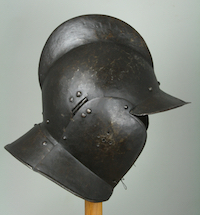
Burgonet circa 1600-20
Augsburg. Rough from the hammer and with an overall blackened finish with areas of wear. One piece bowl with high comb with integral peak. Neck of a single lame, cheek plates with bottom flared to continue the neck lame. Peak with heavily struck Augsburg pine cone mark and less distinct maker's mark (possibly WH). Some remains of lining leathers. Overall very nice clean shape with parts that fit and work well together. Neck lame, cheek plates and hinges appear to be originally part of the same helmet (not associated).
Not for sale.

Closed burgonet circa 1620
Two piece skull joined at the high flat crest with a roll. The crest flat, with a thickness mimicing the roll. Roll formed with the right side rolling over the left side. Base of the roll with a narrow rounded recess similar to the rolls on other parts of the harness. The front and back of the bowl with flat overlapping seams at the ends of the crest. Bevor and brim pivoted at a common point. Base of the skull and bevor with a row of lining rivets. The bevor and skull each with a single large neck lame secured to the skull and bevor with solid rivets on each side, the outer edge with simple inward turns bordered by a row of lining rivets. Visor, brim and hooks excellent replacements by Albert Collins - master armourer in Sweden.
Not for sale.

German Burgonet early 17th century
Of 'Black and White' form with recessed bands on each side of the skull. High, roped comb. Neck plate and brim formed of separate plates, each with rolled, recessed and roped borders. Cheek plates with flared bottom (conforming to the neck plate), raised circle in the center and a raised edge at the face openning. Signs of delamination as is common with authentic pieces. Includes original patch at the tail flare and 2 rivets to stabilize laminations at the forhead. Extremely fine roping on the rolls. Likely indistinct Nuremberg guild mark in the white band near the point of the brim. White bands lightly cleaned to restore original look. Right cheek plate replaced. Overall oxidized and stabilized surface. No signs of cleaning that would affect the surface. Small holes in the comb almost certainly from corrosion. Thickness of the bowl pretty consistently .050 in. Weight 3 pounds (1360 g).
Not for sale.

Burgonet early 17th cent.
German, probably Nuremberg. Rounded skull with tall comb formed of two pieces. The pieces are joined by a flat fold at the top of the comb and flat overlaps in the front and back. Separate brim riveted inside the skull. Separate tail lame attached to the outside of a flare at the back of the skull. Borders of the tail and brim with simple inward turns, the one on the tail rolled around wire. Cheekplates with flared bottom edge following the line of the neck lame. Bottom and front edges with simple inward turns. Cheekplates secured to the skull with internal hinges. This is an interesting example of a relatively degenerate burgonet. Formed of two pieces to simplify construction, separate brim also minimizes metal work and the shape covers somewhat less of the forhead than normal. Even at this level it appears to have been originally ground to a white surface.
Not for sale.

Burgonet early 17th c.
Two piece bowl joined at the center over a short, high central comb by a roll. The remainder joined by a flat riveted seam. The brim formed from a separate piece riveted to the inside of the front of the skull. The back of the skull with a neck guard formed of a single plate. Cheek plates with a flare continuing the line of the neck guard. Main edges with with plain inward turns. With old and probably working life lining quilted canvas lining stitched to leather strips at the forehead and neck. Cheek plates with loops at the lower corners used to secure a lace. The right cheek plate stamped with the number 197. Original black finish which has been refreshed with paint. Right cheek plate appears to have been reattached. Cheek plates secured at the chin in a common way - with a loop at the lower corner of each through which a thong is tied.
Not for sale.

Burgonet early 17th c.
Two piece rounded skull joined at the center along the crest with a roll. Fitted at the front with a pivoted peak and at the rear with a single neck lame. Comb polished bright. Additional bright band at the middle of each side. Peak, cheek plate, and neck lame with polished borders and roped inward turned edge. Right cheek plate lost. Left cheek plate with polished front border and a raised circular area at the center polished bright and pierced with holes. Surface cleaned and black refreshed with paint. The pivoted brim moves very little. It appears that simulating pivoting has been done as an alternate way to secure a separate brim to a burgonet with a two piece skull (instead of riveting it inside as has been done on A-52, A-71 and A-234).
Not for sale.