
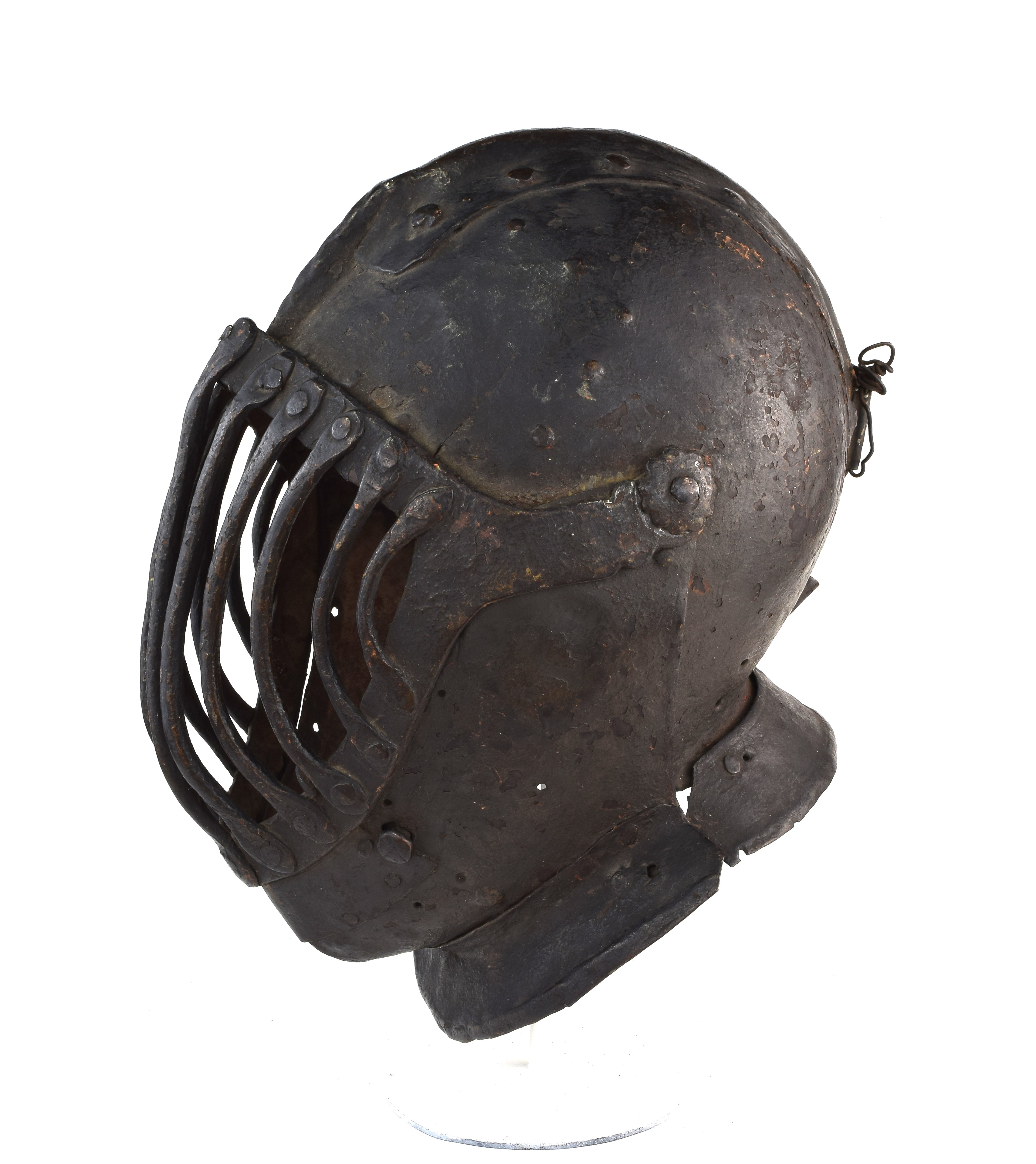
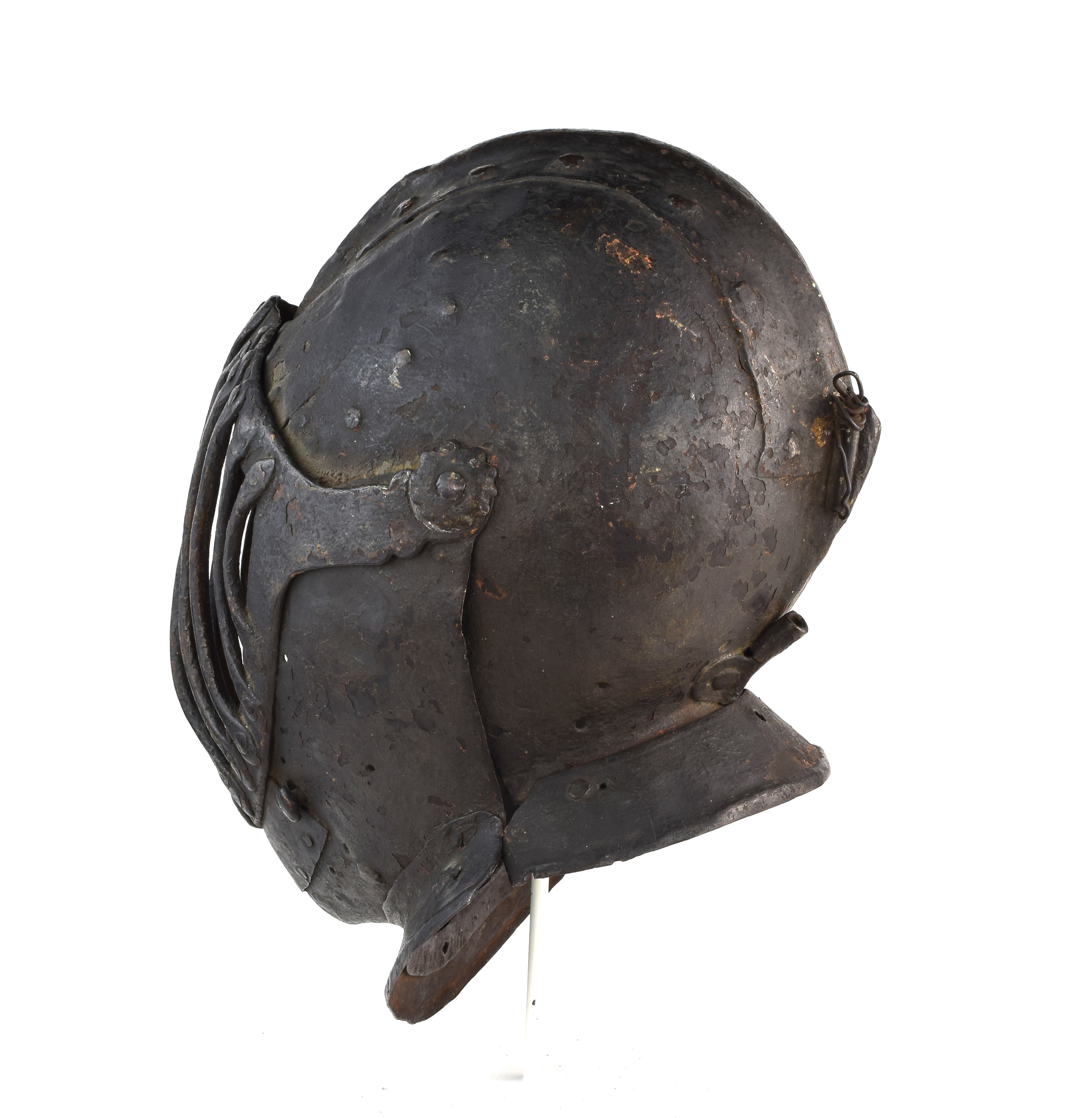
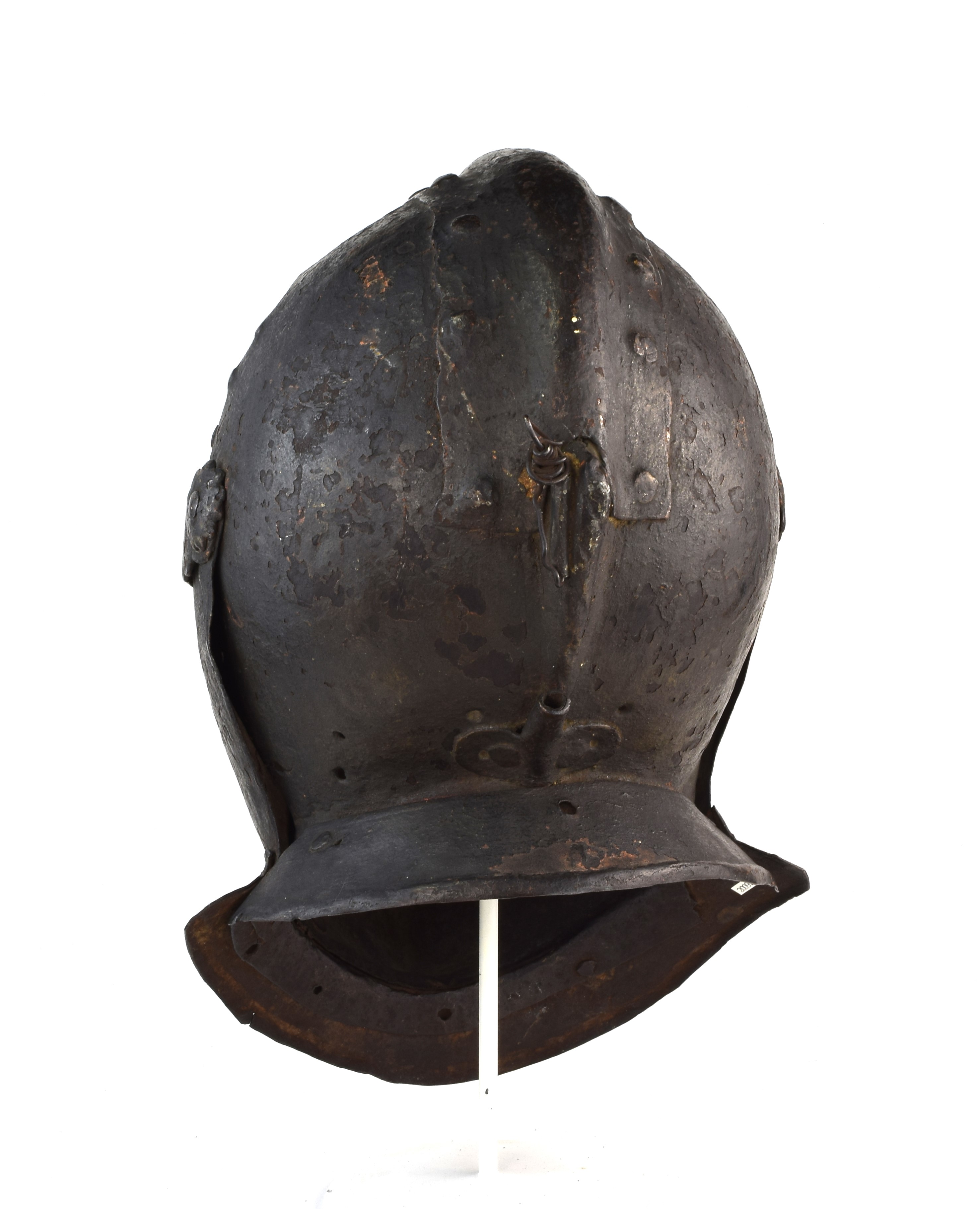
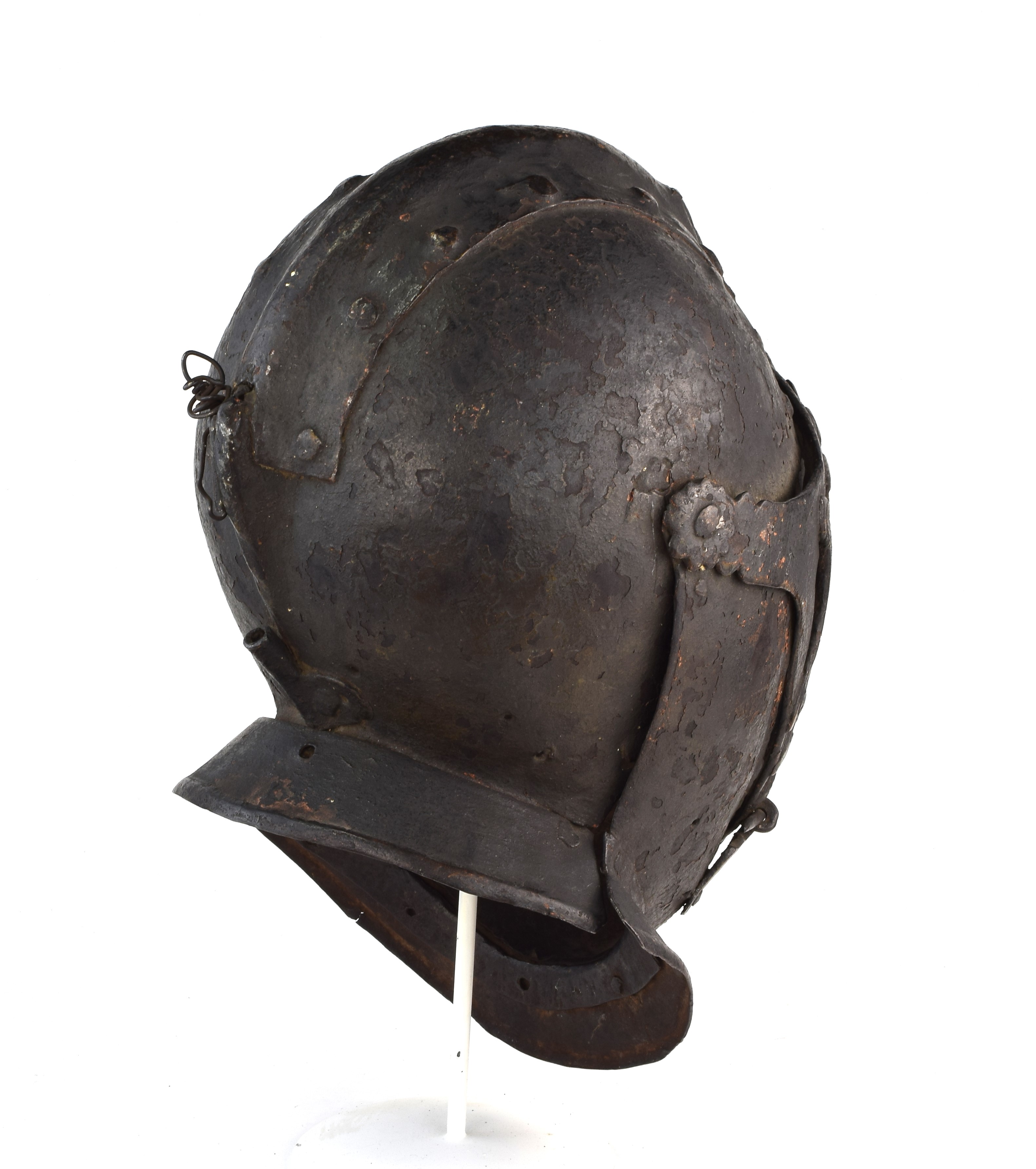


Close Helmet 18th c. and earlier
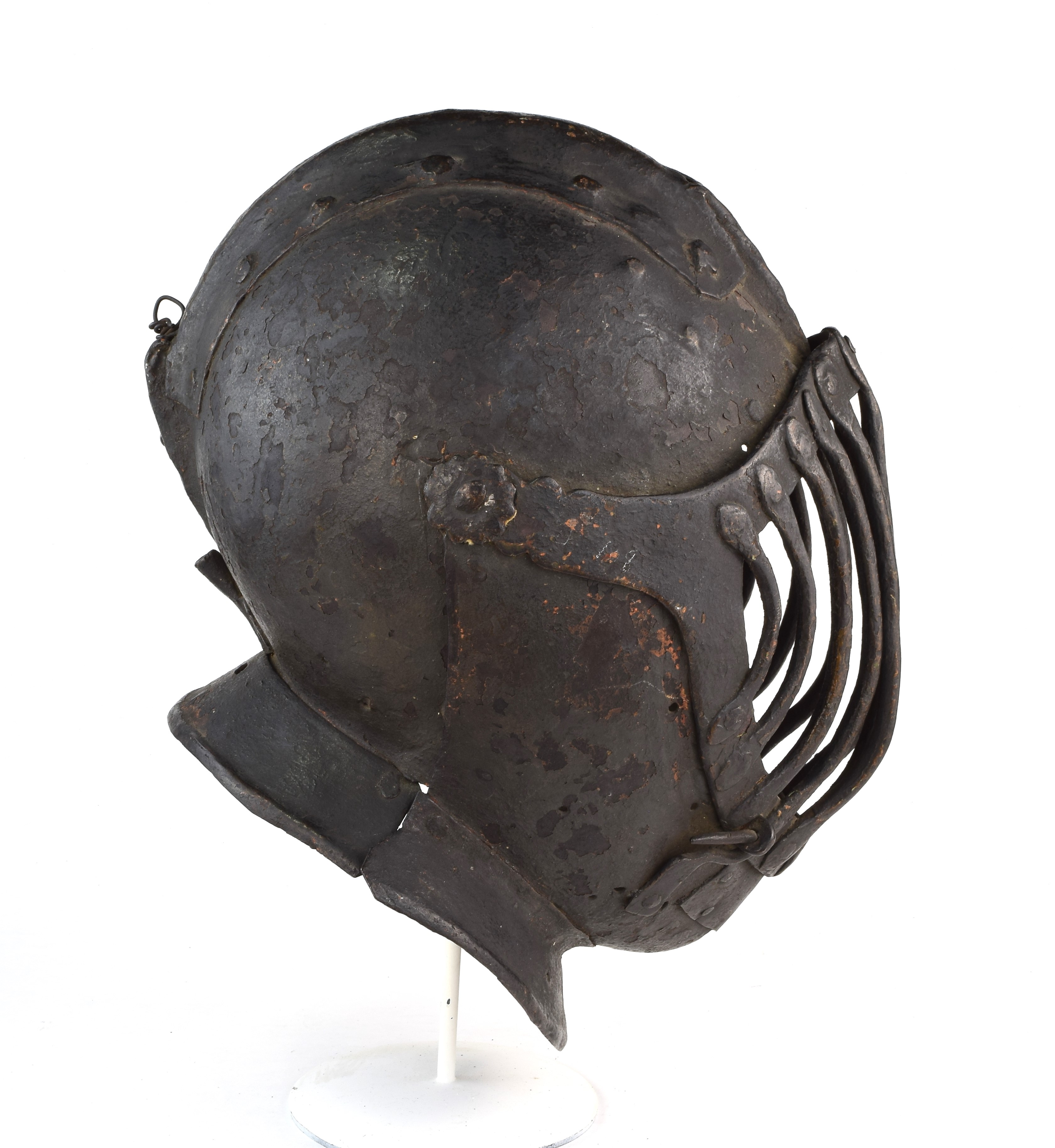
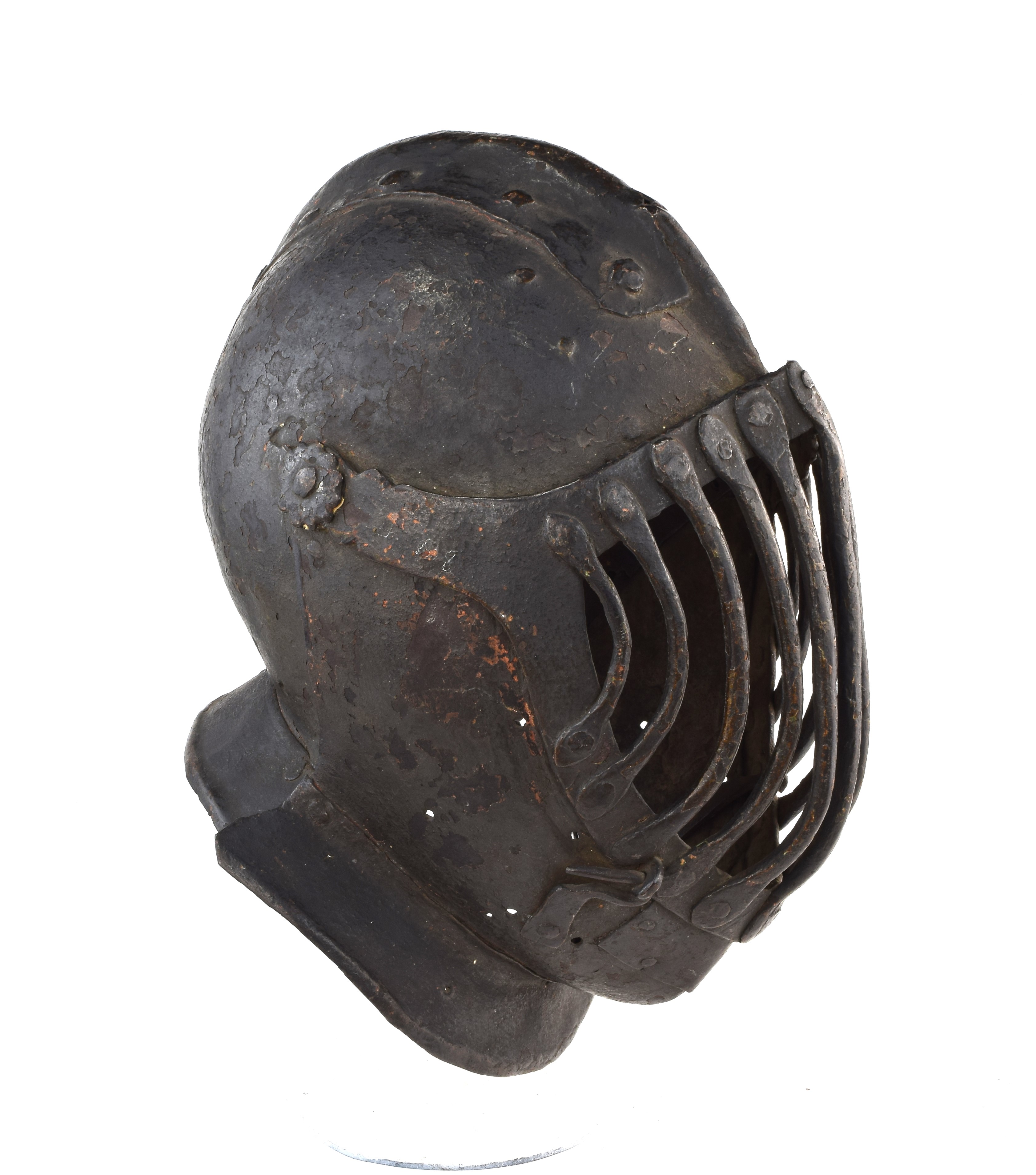
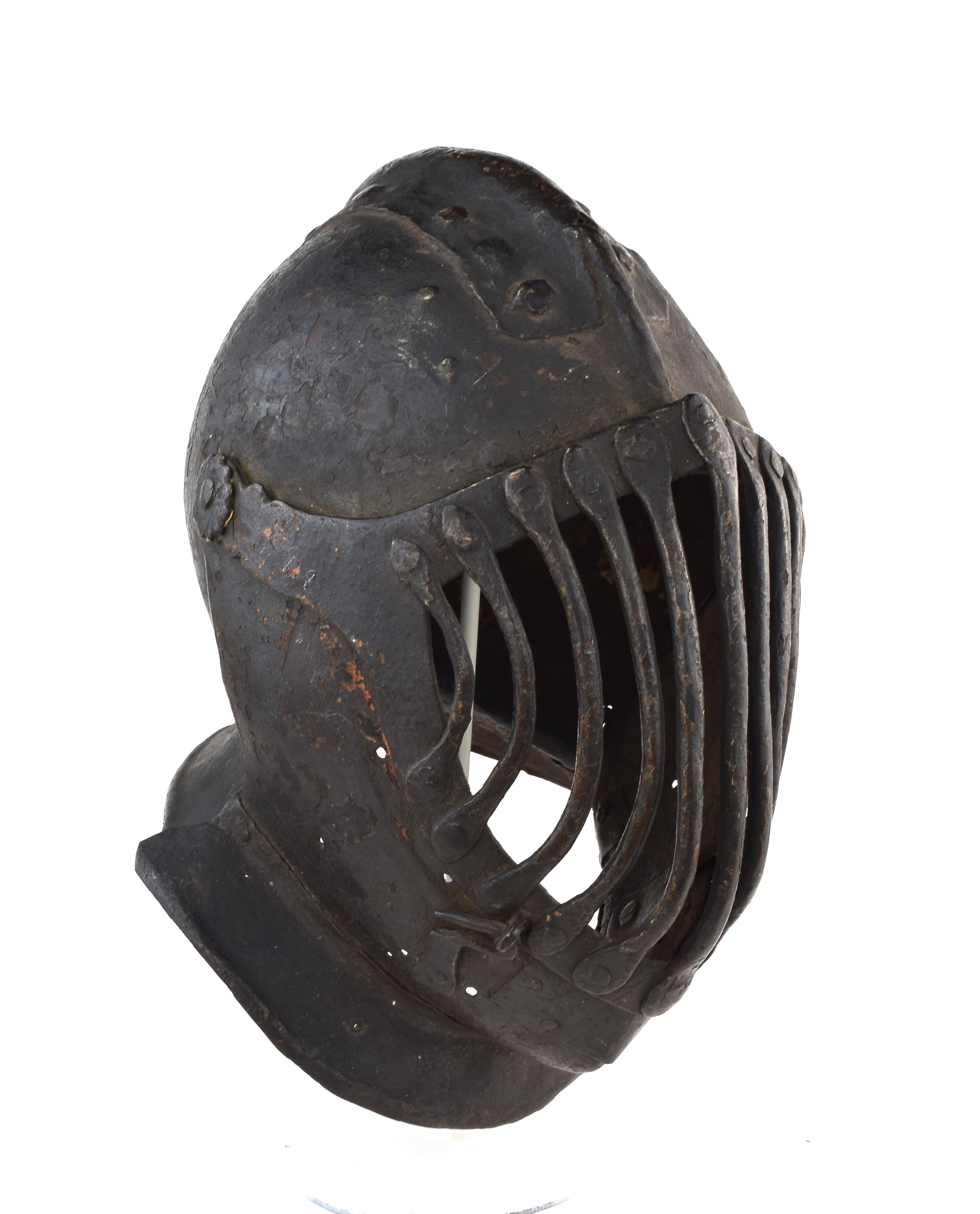
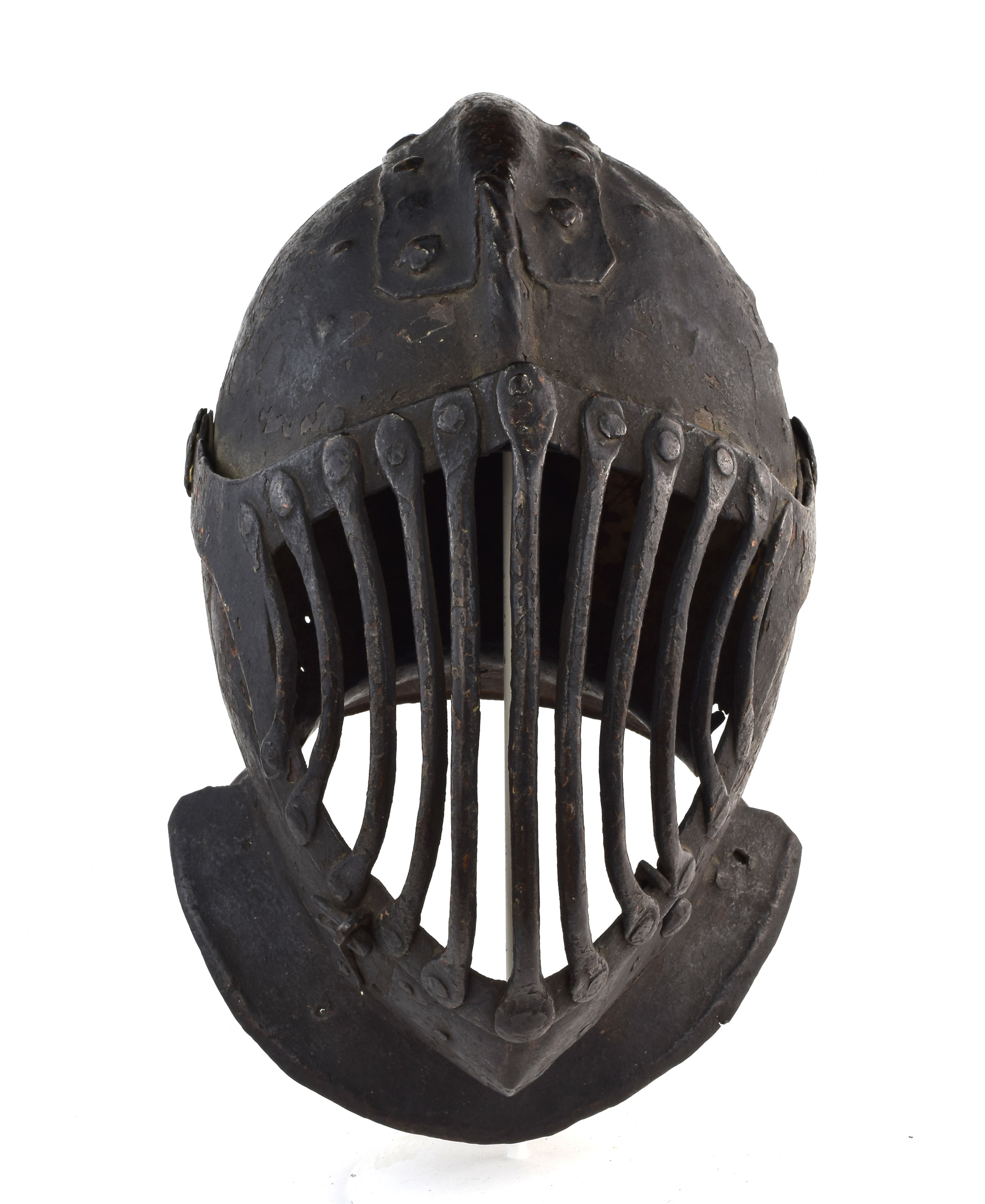
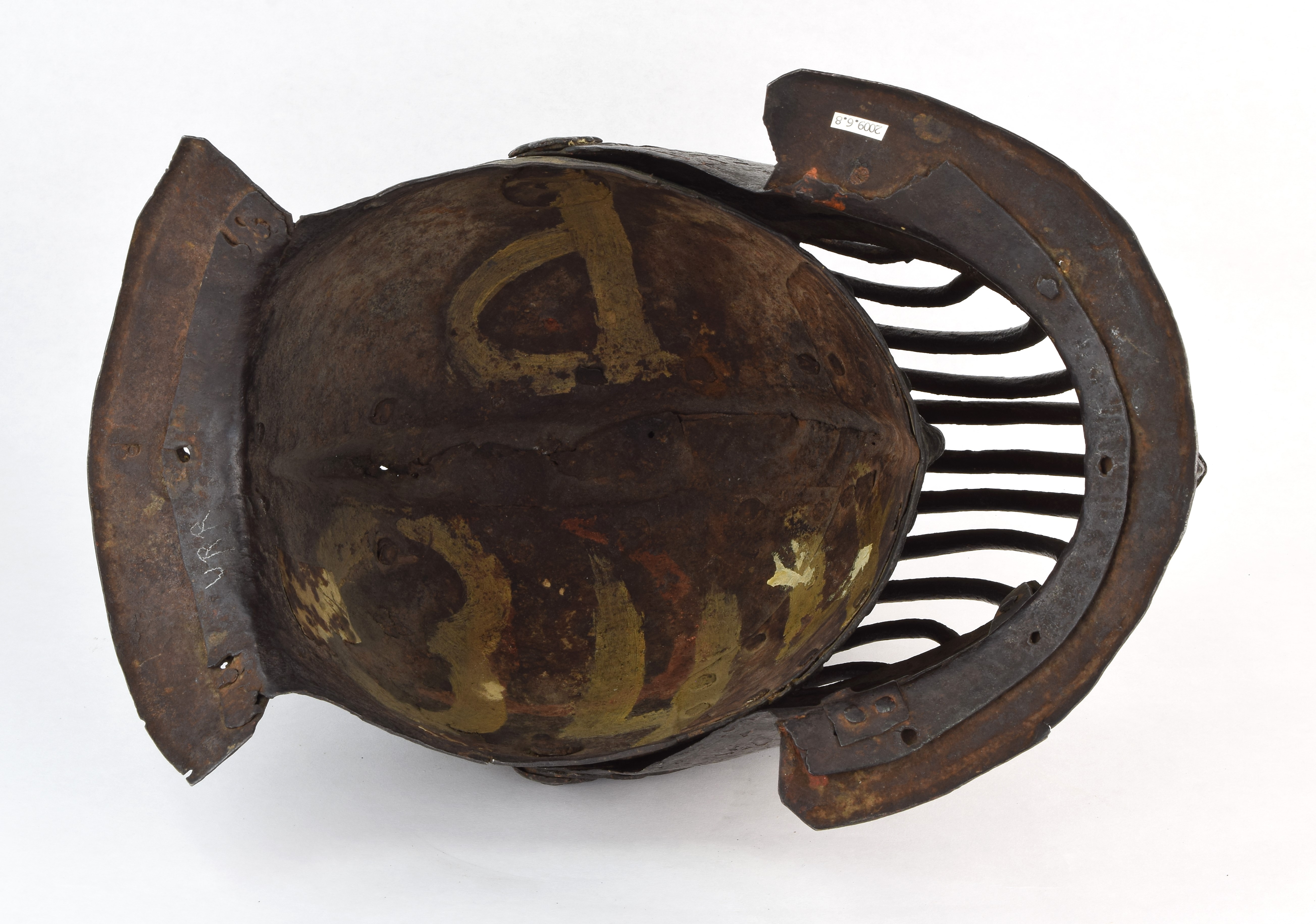
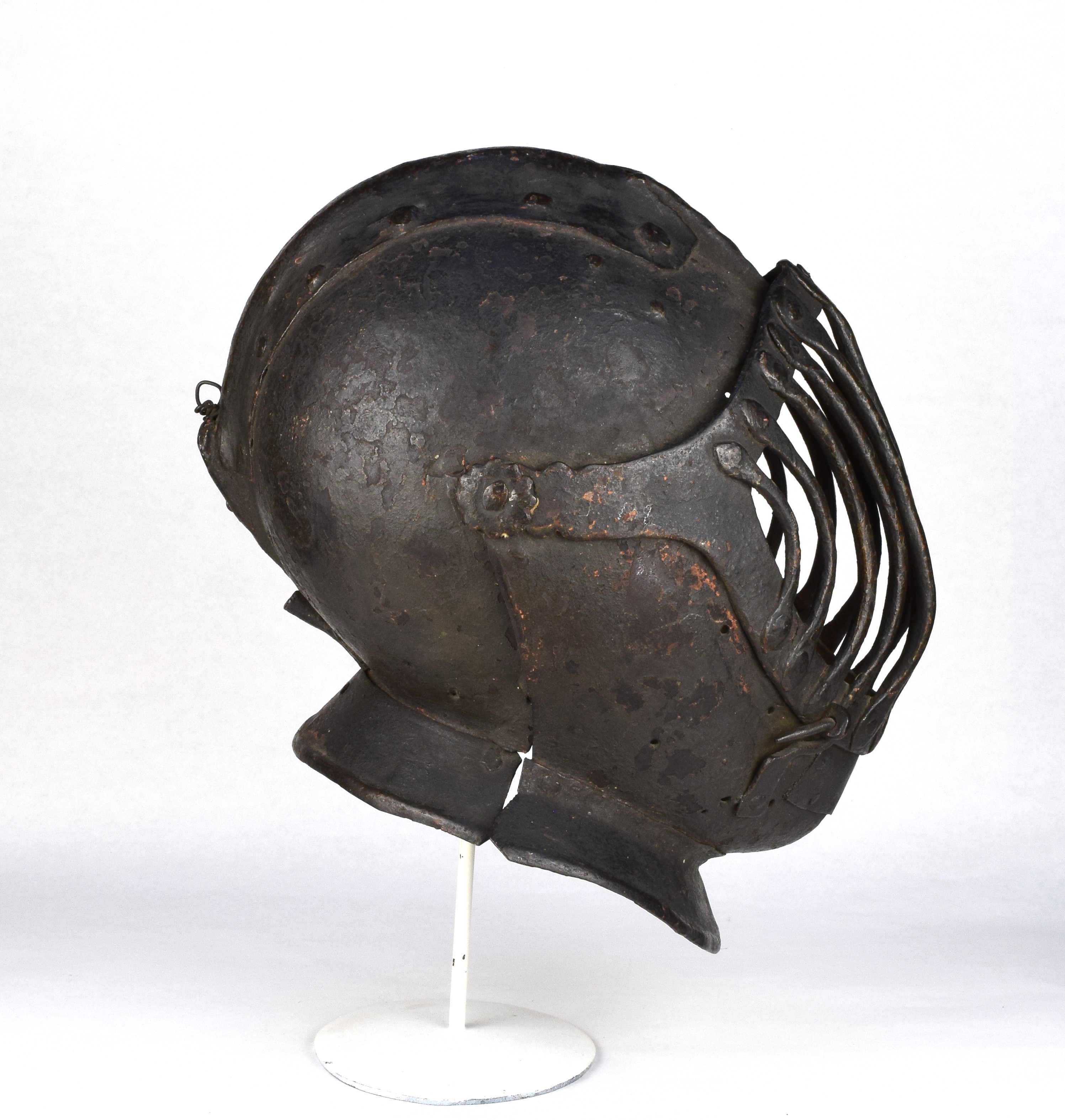
Consisting of a bowl, visor, bevor and single neck lame front and back. Plain one piece bowl with wide rounded and roped crest. Bevor formed to the chin, pivoted at the upper end of each side from the bowl. Bowl and bevor each with a single neck lame. Neck lames with a simple bumped border at the edge. Visor povoted on common points with the bevor and formed of a frame with arms and a large face opening covered with vertically bars. Skull with crudely secured reinforcing plate over most of the crest and inside the front. The interior reinforce covers the brow area above the visor and is offset to provide more coverage on the left side than the right, fixing a crack on the left side of the skull. Visor secured closed with hooks in the bevor - a normal hook engaging a peg on the right and an internal hook on the left. Covered overall with older dark paint with losses. There are some small remains of colored paint - red and gold on the exterior. Interior of the skull painted with a large P on the right side and B344 or 844 on the left side in yellow paint. Some additional red paint. Remains of paper tags glued to the interior (not enough remains to read). Interior of the front gorget plate marked with a rectangular collection tag - 2009.6.8. Collection not identified.
Measurements: Thickness measured in the left rear .081 in. - .10 in., measured on the right .08-.105 in. Bevor .048-.066 in.
This is an interesting piece. The skull, bevor and neck lames were almost certainly made in 1530-50. After it's normal working life for use in warfare, the helmet was adapted for use in the Gioco del Ponte. The patch inside the front of the skull stabilizes a crack in the skull. The patch over the crest covers up major cracks and losses to the crest. Inspection shows that the crest was originally aggressively roped and it was taller than the current form. The neck lames have since been re-attached a little higher than their original position, likely to deal with losses in the main plates where they were secured and to cover up the crack at the transition from the chin to neck flare. It is also possible that they intentionally shortened the neck plates to allow for more movement. They also replaced the original visor with the the barred visor that is typical for GP helmets and added the crude reinforces. Thoughts before I received the piece - Some helmets designed for war use in the 16th and 17th c. are pretty thin. That is all that is needed to stop the relatively small number of actual hits a helmet will take in combat. It is reasonable to assume that the riveted internal and external patches were added to limit the likely damage from being bashed with wooden shields. Other surviving helmets for the GP have reinforcements added to the skull. These vary in style and elegance of manufacture. Having some experience with modern combat with simulated weapons, bashing away on each other and avoiding maintenance requires a heavier/thicker/reinforced helmet than you would often need for war. Once received I have more thoughts. Reinforcement may be part of the goal, but I think that the primary reason for the reinforcements was to resolve issues with the condition of the helmet when it was converted. I think that there were major losses in the comb and a crack in the front left of the skull. So the "reinforces" allowed them to cover up damage and make the helmet usable.
The Gioco del Ponte was a mock combat held off and on from the Middle Ages until 1807 in the center of Piza on a bridge over the river Arno. The combatants use elongated club like shields (targone) to bash each other. The goal of the game was to push the other team off of the bridge. The armor used in these combats was usually old and out of date and "updated" to fit the needs of the game. The most commonly found pieces are helmets, breastplates and backplates. Images of combatants show that they also wore shoulder protection extending down the upper arms and faulds extended to cover the groin. Sometimes the helmets are nearly complete 17th c. helmets, other times they are pretty heavily modified. Some of the earliest are formed from some nice 15th c. armets with the parts riveted together and trimmed. They are often, but not always marked "GP" in crudely chiseled letters. You can see an example of this on the backplate that forms part of item number A-267. There is a fine example of this type of helmet along with a breast and back in the Metropolitan Museum of Art (012.134a and b). The Metroplitan example is still painted, but this seems to have been refreshed. Most have been cleaned. The Metropolitan Museum of Art also owns an example of the shields (targone) used in this contest (14.25.770). The WAM collection also includes one of these helmets (2014.1078) and several targone. One of them is 2014.773.
If you have any questions, please send them to Wade Allen
This site last updated Mon Jan 12 09:08:25 EST 2026